
Up for a Quickie? Why Inventory Clerks Should Think Twice Before Saying Yes to Discounts
Ah, the life of an inventory clerk – filled with the glamorous thrills of counting cutlery, examining carpets, getting down close and personal with the cold, wet tarmac (#watermeters), and documenting the mysterious stains on tenants’ favourite walls.
It’s a job that requires meticulous attention to detail, an ironclad sense of fairness, and an encyclopaedic knowledge of how many wine glasses a two-bedroom flat should theoretically possess. I mean – how many does one bottle of red need?
But amidst all this chaos, there lurks a devious proposition that every seasoned inventory clerk has encountered at least once. It’s sneaky, it’s seductive, and it’s got a name that should raise every red flag in the book: “The Quickie.”
No, I’m not talking about the kind of quickie that requires dim red lighting and a locked door – this isn’t that kind of blog (but nice try).
I’m talking about the other kind of quickie, the one that slips off the landlord’s tongue when they’re looking to cut corners and costs. The one where they wink and nudge, asking for a “quick report,” while subtly implying they won’t be paying the full price.
And let me tell you my fellow inventory clerks, agreeing to this kind of quickie is like walking into a bear trap with a blindfold on – hilarious for everyone else, but potentially catastrophic for you.
The Illusion of Simplicity
The first thing landlords will tell you is, “It’s just a small place! It won’t take long at all!” Oh, the sweet, naive optimism of those words.
As any inventory clerk worth their salt knows, size doesn’t matter (wink, wink). It’s the details that count. That “small” one-bedroom flat?
It’s packed to the rafters with all the quirky knick-knacks and questionable decor choices of its former occupant(s) – someone who clearly spent their entire salary at IKEA and Etsy.
There’s always a drawer stuffed with unmentionables (think students and battery-operated equipment – yup, you’ve got it), tangled cables that could rival Medusa’s hairdo, and that’s before you’ve even started on the kitchen cupboards, which contain enough mismatched Tupperware to stock a small nation.
And don’t even get me started on the bathroom. You think it’s just a loo and a sink? Think again. That’s where you’ll find exotic mould species that haven’t yet been classified by science and half-used toiletries that should have been thrown out three tenants ago.
The Dangers of the Discount
“Just give us a quickie [report], and be a dear and knock a bit off the fee,” they say.
A bit!?!
The problem with “a bit” is that it’s always subjective. What you hear as “a reasonable discount for a little less work” often translates to “let’s see how little we can pay you while making you do almost the same amount of work.” And as every inventory clerk knows, a rushed job is a sloppy job, and sloppy jobs come back to bite you – usually in the form of an irate landlord calling you two weeks later because you forgot to note the missing curtain rod bracket in the living room.
Plus, let’s be honest – what kind of inventory clerk are you if you can’t sleep at night, tormented by the thought that you missed even a single spoon in that cutlery drawer? You don’t want to live with that on your conscience – it’s practically in your DNA to be thorough.
Ask yourself one very important question: are you really willing to trade your peace of mind for a few less quid? Because once you start down that slippery slope of discounts, you’ll find yourself in a downward spiral of diminished dignity and never-ending favours.
The next thing you know, you’re being asked to do a “quickie” on a five-bedroom mansion with a swimming pool, and your bank account is somehow emptier than the tenant’s promises to clean up after their cat.
The Comedy of Catastrophe
And here’s where it gets funny – funny for everyone else, that is. The “quickie” report is almost always followed by some form of calamity.
Perhaps the landlord decides that they actually do want every single scuff mark and light bulb documented in the property condition report, or maybe the tenant disputes your findings because you were “too quick” to notice the crack in the ceiling that only appears at a certain angle in the afternoon sun.
Either way, you’ll be called back to redo the report you should have done ‘properly’ in the first place. And this time, you’ll do it for free because, well, “we already paid you for the first one.”
This is the part where you slap your forehead, give yourself a right good telling off, and realise that agreeing to a “quickie” was akin to volunteering for the world’s least amusing slapstick routine – one where you’re the clown, the custard pies are the landlords, and your self-respect is the one thing that doesn’t get to take a bow at the end.
Just Say No!
So, when the next landlord sidles up to you with a suggestive smile and a casual, “Fancy a quickie?” Remember this: A quickie might sound like a shortcut to an easy payday, but it’s actually a one-way ticket to unpaid overtime hell.
Protect your time, your dignity, and the thoroughness that makes you the hero of every agent and the fearsome foe of every sloppy landlord.
Say No to Quickies, and say Yes, Yes, Yes! to full-priced, detailed, comprehensive, and industry-leading inventory reports.
Security Cameras in Rental Properties: Who’s Watching Who?
Security cameras are everywhere these days, and rental properties are no exception. While they can provide peace of mind for tenants and landlords alike, they also raise some thorny issues around privacy, legal rights, and professional conduct – especially for those of us in the property industry.
Let’s break it down: who can install cameras, what rights landlords and tenants have, and what property managers and inventory clerks need to be aware of when working in properties that might be recording their every move.
Can Tenants Install Security Cameras?
Short answer: yes, but….. with some caveats.
Inside the Property: Tenants can usually install cameras indoors – think of those plug-and-play models – but only if they don’t damage the property or break the terms of the tenancy agreement.
Outside the Property: This is where it gets trickier. Cameras on external walls, door frames, or overlooking shared or public spaces often require landlord approval. Privacy laws also come into play, especially if the cameras record areas beyond the tenant’s control.
The golden rule here? Communicate.
Tenants should always get written permission from their landlord before setting up any security equipment.
What About Landlords?
Landlords are walking a tightrope between ensuring security and respecting privacy.
Where They Can’t Go: No cameras in private spaces – bedrooms, bathrooms, or anywhere tenants have a reasonable expectation of privacy.
Where They Can: Communal areas like hallways or car parks, but only with proper signage and tenant notification.
The Legal Stuff: If cameras capture public spaces or personal data, landlords may need to comply with GDPR (in the UK, at least). That means registering with the ICO, securing the footage, and making sure tenants know what’s being recorded and why.
Why Inventory Clerks and Property Managers Should Pay Attention
Here’s where things get really interesting. If you’re inspecting properties, you might already be on camera. So, what do you need to keep in mind?
1. You’re Probably Being Filmed
That quirky chat about last night’s TV or perhaps a personal conversation regarding your next job while wandering through a property? It might be on tape. Cameras are small and easily hidden, and tenants or landlords don’t always disclose they’re in use. So, professionalism is key.
Act Like You’re Always On Camera: Be respectful, stick to the task, and avoid any actions or comments that could be misinterpreted later.
Consent Matters: If you’re uncomfortable with being recorded, you’re within your rights to raise this with the managing agent or landlord.
2. Spotting and Reporting Cameras
Part of your role is documenting the property, and that includes security cameras. Make sure you:
Note the location
Note the type of camera (if known)
Highlight damage caused by installations (especially if the cameras weren’t approved by the landlord)
Flag any installations that might violate privacy laws. This could be along the lines of a camera pointing at the neighbour’s garden or in the bedroom.
3. Don’t Get Dragged Into Data Protection Issues
You’re there to inspect, not to mess with security systems. Handling footage or interacting with tenant-installed cameras could land you in hot water with GDPR or similar privacy laws. Unless you’ve got explicit permission, steer clear.
Why This Matters
Security cameras can create trust or erode it, depending on how they’re managed. Here are a few common pitfalls:
Privacy Disputes: A tenant installs a camera without telling the landlord, and suddenly the neighbour is complaining about being recorded.
Professionalism at Risk: A stray comment or careless action caught on tape can damage your reputation in seconds.
Data Mishandling: Clerks or managers inadvertently viewing or sharing footage can lead to serious legal repercussions.
Best Practices for Clerks and Managers
Let’s keep it simple:
- Ask Questions: If you see cameras, find out who installed them, why, and whether it’s all above board.
- Be Professional: Always assume you’re on camera, even if you don’t see one.
- Stay Neutral: If there’s a dispute over cameras, stick to the facts and report them accurately in your inspection notes.
- Keep It Legal: Don’t touch or interact with security systems unless explicitly authorised.
My Final Thoughts: Let’s Talk About Trust
Security cameras can be a great tool for keeping properties and their occupants safe, but they need to be used responsibly. Whether you’re a tenant, landlord, or property professional, the key is clear communication and mutual respect.
For inventory clerks and property managers, there’s an added layer of responsibility. Your professionalism and attention to detail are more important than ever when you’re working in properties where you might be watched so always act as you are!
Rising to the Challenge of Change: Can Inventory Providers Lead the Way in 2025?
Let’s be frank: the lettings market in 2024 is and continues to be in turmoil.
Around 30% of landlords are either drowning under the weight of compliance and cost pressures or packing up altogether, abandoning the sector. And can you blame them? The government piles on regulations faster than anyone can respond, leaving landlords stuck between a rock and a hard place, forced to either brace themselves for another legislative storm or cut their losses and leave.
Meanwhile, tenants are facing a rental market in utter disarray. Rents are climbing 10% year-on-year, with families paying more for less. Demand is outstripping supply to such an extent that the lettings process feels like musical chairs, except there’s no music and nowhere near enough chairs.
And inventory providers? We’re right in the thick of it all.
But here’s the uncomfortable truth: while we pride ourselves on being central to the lettings ecosystem, how much do we actually know about our own sector? Who’s thriving, who’s buckling under pressure, and (most importantly) how are we evolving to meet the demands of a market that seems to shift with every passing moment?
A Market Under Siege
The Renters’ Rights Bill is expected to land by July 2025, and its ripple effects are already making waves. No more Section 21 evictions. Periodic tenancies as the new normal. And let’s not forget the Decent Homes Standard, which will hold landlords to a level of accountability they’ve never faced before.
These are major shifts, and the warning signs are already flashing:
- 30% of landlords planning to sell or exit the market.
- Rents soaring as demand massively outstrips supply.
- Over 60% of landlords naming compliance as their biggest headache. (Goodlord Lettings Report 2024)
This is not just a challenge – it’s a battle. For inventory providers, the landscape is no less fraught. How many providers are still operating? How many have quietly slipped away? And, critically, are we ready to shoulder the increased demand that will inevitably come as landlords scramble to comply with yet more legislation?
What’s Happening on the Ground
From my vantage point, it’s clear that inventory providers are responding to this upheaval in markedly different ways. Some are rising to the occasion, innovating and adapting, while others seem paralysed by the pace of change.
Take a recent example I encountered: one provider has overhauled their inspection processes to align with Decent Homes standards, proactively using Inventory Base templates and the Fitness for Human Habitation legislation. The result? Not only are they meeting compliance head-on, but they’re also cementing themselves as trusted allies to landlords; advisors, not just service providers.
And this is the crux of it. Our role is no longer just about recording the state of a property. It’s about safeguarding compliance, protecting investments, and ensuring smoother, less contentious tenancies. Those who fail to see this will be left behind.
Why It Matters
Let me be frank and blunt: the lack of clarity and cohesion in our sector is holding us back. We have no meaningful data on our own performance. We don’t know who’s succeeding, who’s struggling, or what best practice really looks like. And as a result, we’re stumbling where we should be sprinting.
- Missed Growth Opportunities Without clarity, we risk stagnation. Are we attracting the next generation of providers? Scaling fast enough? Innovating where it counts?
- No Advocacy for Ourselves Inventory providers are crucial to compliance and risk management, but our role is often overlooked or dismissed. We need to make our voices heard—loudly and unapologetically.
- Vulnerability to Disruption Emerging providers, unburdened by legacy systems or old habits, are moving faster and more efficiently. If we don’t adapt, we will be left in their wake.
- No Benchmarks Without data and standards, how do we measure success? Are we competitive? Are we delivering genuine value?
What Needs to Happen
This is a defining moment for our sector. To meet the challenge, we must:
- Leverage Resources: Take advantage of insights from organisations like Propertymark to ensure we are leading on compliance, not chasing it.
- Define Standards: Step up and set the benchmarks ourselves. What does excellence look like in our industry? We must lead the conversation.
- Be Proactive Partners: Landlords and agents need guidance now more than ever. Inventory providers must position themselves as their go-to experts, offering practical solutions to navigate the changes ahead.
And let’s not forget: innovation is not optional. The tools are there – advanced templates, streamlined processes, and technology that empowers providers. It’s time to embrace them fully.
The Opportunity Ahead
For what it’s worth, my final thoughts:
The lettings sector is under siege, but 2025 brings a defining moment – a chance for inventory providers to step forward, not just as participants in this industry but as leaders. The challenges ahead are real: the Renters’ Rights Bill, the Decent Homes Standard, and a market under intense scrutiny. But with challenge comes opportunity.
Inventory providers are uniquely positioned to lead – not just to react, but to anticipate, guide, and shape the future of the sector. By 2025, the market will need more than checklists and reports; it will need expertise, innovation, and leadership.
Here’s what stepping up looks like:
- Drive Innovation: Embrace tools like geolocation, smarter reporting templates, and automation. These technologies aren’t just extras – they’re critical for scaling your operations and handling the increased demand.
- Navigate Legislative Change: Stay ahead of the Renters’ Rights Bill and the Decent Homes Standard. Build expertise in these areas now so you can offer landlords and agents proactive solutions and position yourself as their go-to compliance expert.
- Build Relationships: Strengthen partnerships with landlords and agents. Show them you’re not just a service provider but a trusted advisor who can help them navigate change and succeed in a challenging market.
- Set the Standard: Take ownership of your role in shaping industry benchmarks. Lead by example in reporting quality, efficiency, and value, and set a high bar that others will follow.
2025 is going to be a turning point for the lettings industry. It’s time to take the pieces of this fractured market and build something stronger, more resilient, and fit for the future.
The market doesn’t need passive spectators – it needs leaders, innovators and problem solvers. The question isn’t “What’s next?” It’s “Who’s ready to lead?”
I’d love to hear your thoughts. How are you preparing for the challenges and opportunities ahead? What changes do you think are needed?
Carbon Monoxide Alarms – What Inventory Clerks Need to Know
1st October 2022 is a date that should be marked firmly in red on the calendar of every landlord, letting agent and inventory clerk in the UK.
From this date, all rental properties, whether they are rented out by private landlords, housing associations, local authorities or any other body, must be fitted with a carbon monoxide alarm in any room used as living accommodation which has any kind of fixed combustion appliance, including gas boilers.
New regulations
Under the Smoke and Carbon Monoxide Alarm (England) Regulations 2015, private landlords were obliged to install at least one fully functioning smoke alarm on each floor of a residential property where a room is used as living accommodation but the update to regulations now include carbon monoxide alarms.
Under the new regulations updated in July 2022, and as part of the government’s ongoing programme of reform in the residential rental sector, there is a modest change to the requirements concerning smoke alarms.
One alarm per floor remains sufficient but the requirement has been extended from private rentals to include social rented homes such as those provided by housing associations.
However, the incidences of carbon monoxide poisoning have not been reduced to the levels envisaged when the 2015 regulations were brought into force so a stricter requirement is being introduced.
The only exceptions to this rule are gas cookers, which have been shown to be responsible for very few cases of carbon monoxide poisoning so are (as for now) out of scope..
The new regulations place this broader obligation squarely on the landlord but inevitably, compliance and enforcement will involve letting agents, whose day-to-day management of a landlord’s property puts them in the front line.
Carbon Monoxide alarms in the property
Inventory clerks are in a unique position to play both a reactive and a proactive role in ensuring that landlords comply with the regulations.
Although you may not have a direct legal responsibility in your capacity as a property reporting professional who carries out property reports and inspections, it is essential you understand what is required and what to do if you discover potential safety breaches.
In the course of a check-in, you should identify every room which falls under the scope of the updated regulations.
If the requisite alarms – carbon monoxide and smoke alarms – are not in place, the landlord must be alerted as quickly as possible because the tenancy cannot and should not begin until this is rectified.
If you are satisfied that every qualifying room does have a smoke or carbon monoxide alarm, you need to verify that it is functioning correctly. Because the regulations are not prescriptive about the type of alarm, some may be mains powered while others are operated by batteries.
Please refer to Building Regulations as noted by FireAngel – Part 6 of BS 5839, which outlines the code of practice for the design, installation, commissioning and maintenance of fire detection and fire alarm systems and carbon monoxide alarms in domestic properties
Testing of carbon monoxide alarms
Whatever the type, virtually all of them are relatively easy to test – watch our video.
They will incorporate a test button which, when pressed, should cause the alarm to sound. If this does not happen then, then you must record the failure in the report and notify the client.
Once the landlord or letting agent has been informed, they must arrange repair or replacement before the tenancy begins. The solution may simply be to replace the batteries, or there might be a more complicated wiring problem to be resolved.
Either way, it must be attended to urgently.
During the tenancy, if the tenant discovers that a battery-powered alarm is not working, it is their responsibility to check and change the batteries if necessary. However, if this does not fix the problem, or if the alarm is mains powered, they should report this to the landlord.
Inventory clerks can play an important part in this, because it is entirely possible that a tenant won’t even think about the condition of the alarms. In contrast, inventory clerks are experienced in detailed assessments of safety matters and you should make it part of your reporting routine to check.
To help guide you; all Inventory Base templates have a health & safety section to prompt you for information on the alarm, its location and test result
Your findings should form part of any property inspection, whether at check-in, check-out or as part of an interim property visit, and it is good practice to record any malfunction rather than relying on the landlord to pick it up from the report.
Testing alarms and reporting on their condition should therefore become second nature to inventory clerks but there are also potential safety concerns, not just for the tenants but for you as a clerk.
Safety at the property
When you enter a property to carry out an inspection, if the alarms do not work, you could be at risk of harm from an undetected leak. It’s therefore important to be able to recognise the signs.
There are a number of indicators to look out for:
- a flame from the hob which is yellow or orange instead of blue
- dark soot stains around gas appliances
- excessive condensation on windows
- a pilot light that won’t stay lit
All these are reasons for concern.
As an inventory clerk, you will spend a significant amount of time in a property so if the property has a leak, you might start to feel some unpleasant physical sensations. These may include:
- dizziness
- nausea
- breathlessness
- headaches
In severe cases, inhalation of carbon monoxide can lead to collapse and even unconsciousness. If you experience any of these symptoms, you should immediately open windows and doors to let in as much fresh air as possible.
You shouldn’t hesitate to leave the property even if you haven’t been able to complete your inspection. Your safety is paramount.
The property inventory software we provide at Inventory Base makes it easy for clerks to detail any problems or suspicions they have.
However, always think safety and never not put yourselves at risk because carbon monoxide is extremely dangerous and can rapidly become life-threatening.
Key takeaways
New regulations for Smoke & Carbon Monoxide Alarms come into effect as of 1st October
It’s therefore more important than ever to ensure that alarms are:
- listed in all inventory, check in, mid term and check out reports reports under ‘Health & Safety’
- correctly installed i.e heat sensors for kitchens, carbon monoxide in rooms with a combustion appliance (excluding gas cookers).
- located to each storey (where applicable)
- tested for audible tone and results captured and noted
- missing, faulty or damaged alarms are reported so that they can be repaired/replaced
Indisputable evidence is key to ensuring the safety of the tenants and property, minimising the risks of non compliance and or fines of up to £5,000 if the landlord fails to comply with council or local authority remedial notices.
Video is the best evidence to ensure compliance and your activity as the inventory provider should the tenancy go to dispute and or court if the landlord is fined.
Talk with your client base as to how your services can protect all parties in the tenancy, make any changes to your reports information and layouts so that safety information is shown at the start of the report and if not already optimised, add Video to your reporting options.
Missed Appointments – What Inventory Clerks Need to Know
Missed appointments are the bane of every service industry business, from estate agents to plumbers, from lawyers to hairdressers. For a commercial concern, time is indeed money and a missed appointment is not only time wasted but a lost opportunity for other work and therefore revenue.
It’s widely accepted that every missed GP appointment costs the NHS £30 and the overall scale of the loss is phenomenal: every year 9.6 million appointments are not attended by patients, equating to a cost of £288 million to their already overstretched budget.
While there is nothing but anecdotal evidence of the extent of losses sustained by the various UK business sectors as a result of missed appointments, the experience of the health service is a salutary one.
The economics of being an inventory clerk
The private rental sector relies on the participation of individuals with specialised skills, not just letting agents, maintenance services and safety certificate providers but also those whose contribution is not, let’s be honest here, always appreciated, and that includes inventory clerks.
Looking at inventory clerks specifically….
There are many companies who employ or contract with clerks to carry out property inspections and there are also plenty of clerks who work as sole traders in their own right.
As an inventory clerk, most people need as full a diary as possible to deliver a decent income.
The going rate for the larger companies to conduct a property inspection of a 1 bedroom, furnished house or flat can be anywhere between £100 and £200 in and around the London area.
Sole traders will generally charge less than this depending on the region / area covered, contracts with local agents etc but as with any business, prices are costed carefully to suit the market and give them a sustainable business.
An inspection of a larger property can take up to 3 hours or more so the daily maximum that is probably achievable is 4 inspections but often fewer depending on the size, furnishing level, condition and travel time for keys.
So, if 3 inspection appointments have been booked for a single day, and one tenant, landlord or letting agent who has agreed to be present, fails to turn up, or the inspection has to be abandoned because the tenant has not yet moved out or maintenance is still ongoing, that equates to an immediate 33% reduction in the clerks expected earnings because of missed appointments.
Based on an average of £75 per report (mean), the potential loss of revenue from an industry wide perspective could be a lot more expensive than missing GP appointments.
Data on missed appointments
Although there is no actual data for this sector, we have enough experience of working with companies and SME’s in the property industry to know that missed appointments are unfortunately not rare.
Although considered by some as an occupational hazard, one way to combat the losses suffered is to put report rates up, that way clerks can build a financial buffer against their losses.
However, this puts pressure on landlords and strains business relationships as they either have to accept the increased costs of inspections or reimburse the clerk for the failed appointment.
Unfortunately for landlords, they are unable to reclaim that cost from their tenant because of the Tenant Fees Act 2019.
This legislation strictly limits the circumstances in which landlords can charge their tenants for anything beyond the normal rent, deposits, any variations in the tenancy requested by the tenant, late payment surcharges plus any utilities bills (subject to the terms of the tenancy agreement).
Liability attaches to the tenant only if they have made their own arrangements for a property inspection so you could ask yourself why do we not do more more to offer reports direct to tenants? Food for thought….
Passing on the cost
Moving the cost of missed appointments to the landlord may fill the immediate financial hole but it doesn’t do anything for the ongoing relationship between the parties.
As clerks, you rely on regular clients as the basis of your business so it’s not wise to alienate an otherwise satisfied customer.
So it’s preferable to sit down with the landlord and or the letting agent, if they use one, to discuss ways of working together to eliminate or minimise missed appointments.
Causes of missed appointments
It’s impossible to legislate for discourtesy and unreliability, this happens and is a fact in everyday life, but most tenants are reasonable people who understand that accurate inventories and check outs are in their interest and so wouldn’t necessarily seek to inconvenience clerks or landlords.
It’s really not in their interest and to be fair, in my experience, tenants often react favourably towards clerks as we are seen as impartial.
Of course, there are other reasons why appointments fail and it can happen even when a tenant is absent by mutual agreement.
You might not be able to get hold of the keys, or the landlord may have had new locks fitted without notice. This happens a lot!
An emerging and increasingly more common issue is the fact that tenants are finding it harder to move and are often let down by other parties in the rental chain. This can mean they literally have nowhere to go and leaving even on an agreed date is longer an option for them.
However, no matter what the reason is behind the delays or missed appointments, many of these problems can be resolved and or at least proactively managed with a little forward planning.
How do you solve the problem of missed appointments?
It’s easy to talk about improving communication but with busy work schedules, often there is no time in the day to stop to sort out the admin so one solution is to utilise the automated systems and features already at your fingertips within Inventory Base.
Specialists in developing inventory property management software, Inventory Base really does make the role of inventory clerks more streamlined and simple.
The property inspection app offers so much more than a way to manage the inspection itself.
- Use your account features and tools
Using integrated tools to book / schedule appointments and issue appointment reminders to tenants and landlords by automated SMS is one way to combat the thorny issue of missed appointments.
Inventory clerks can monitor schedules, keep diaries up to date and receive advanced and instant notifications when a tenant or the commissioning agent cannot keep an appointment through client messaging.
- Customise emails and messages
This is an option available to Enterprise users where you can customise emails sent out to Clients, Tenants, Landlords and Agents when a booking/report is created, completed and/or closed.
It is also possible to customise SMS messages here too.
- Contact your clients
Keep in regular contact with your client base to raise awareness of all the methods and options open to them so that they know how to get in touch.
Calling agents, landlords and clients the day before the appointment to confirm keys and ask if there has been any changes to the booking.
You can also do this via messaging however often I find it’s better to call and it also helps maintain the relationship with them especially during busy periods like student season as everyone is so busy it’s easy to ‘drop the ball’ creating the conditions for missed appointments to occur.
And because all these options are all included in our property management software, they’re easy to set up as far in advance as circumstances allow and will substantially improve communication between all parties.
Final thoughts…
There will always be occasions when appointments fail, but with Inventory Base in your reporting armoury, you can manage the problem and keep the issue of missed appointments to an acceptable minimum.
Reporting software is an investment but with Inventory Base, it’s one that delivers value and can help you to maximise your time as well as your income and make missed appointments a manageable rarity.
Key takeaways
- Always use contacts to record tenant contact details and make sharing of reports quick and easy – see support guide
- Provide clients and tenants with a business phone number to contact you if either party are delayed
- Use the SMS option to send out auto reminders of appointments – see support guide
- Check with clients the day before the appointment in case of any last minute changes to the booking or key location
- Customise your emails to help inform tenants of your check out process and methods of contact should their move be delayed – see support guide
- Keep up to date with latest features, changes and more via your booking account – see releases
Book a demo and find out how Inventory Base can help you to combat missed appointments and make inspection and property Inventory reporting simple!
Section 21 repeal – will the balance of evidence change?
The repeal of Section 21 is seen as one of the biggest, most fundamental changes to housing legislation since WW2. Although agents and landlords fear the change, Shelter believes this is a ‘game changer for 11 million private renters and will level the playing field’.
But what does this mean for inventory providers and will the repeal of Section 21 change the balance of evidence needed when it comes to deposit disputes?
A bit of history
Section 21 of the Housing Act 1988, providing for so-called ‘no-fault’ evictions, has seen its share of controversy over the past 30 years.
Governments of left and right shifted the balance of power back and forth between landlords and tenants after the second world war, with Harold Wilson‘s legislative programme of tenant protections dominating from 1964 until 1979.
The Thatcher government’s enthusiasm for deregulation extended to the private rental sector, and it was The Housing Act 1980 which introduced the concept of the shorthold tenancy, granting new rights for landlords to ask the courts to terminate a tenancy. Reform went further with the 1988 Act, which brought into law the Section 21 procedure which has been in place ever since.
Since at least 2014 it has been on the Conservative government’s agenda to repeal Section 21 as part of new reforms designed to reset the balance, and after years of delay the government of Boris Johnson announced in the Queen’s Speech in 2022 that Section 21 eviction notices would be abolished in the new parliamentary session.
These intentions were formalised as long ago as the Renters Reform Bill, drawn up in 2019 to strengthen the rights of tenants. However, judging by the progress of the Tenant Fees Act, this is unlikely to happen for 18 months to 2 years.
Like the divorce rules, the ‘no-fault’ provision was intended to eliminate convoluted court cases and intensive evidence gathering. Unlike divorce, Section 21 could only be invoked by one-party. Tenants were free to terminate a tenancy with the appropriate notice, but that was the only right it afforded to them.
Section 8
Under the proposed changes landlords will in future be compelled to use Section 8 to evict tenants, a section of the act which requires the landlord to show their reasons for wanting to end a tenancy. This has always been available to landlords but they usually need to demonstrate that the tenant was in breach of a tenancy condition.
One of the changes will be the widening of acceptable grounds for ending a tenancy to include situations such as the landlord wishing to sell or move into the property themselves, although such instances would appear to be in the minority.
The main impact for clients of Inventory Base and other property service providers is the increased importance of evidence gathering.
In the past, landlords tended to use Section 21 in preference to Section 8 precisely because it was easier and needed no extended argument. In the absence of Section 21, they will have little choice but to go down the route of evidence-based action.
Will the repeal of Section 21 create uncertainly or opportunities?
This repeal of Section 21 will clearly affect the status of property inspection reports and what landlords will require inventory clerks to include.
The shift will cause upheaval and uncertainty as the industry adjusts. Landlords will have to ensure that their means of gathering evidence and keeping records are at a standard capable of satisfying Section 8 requirements.
Because the procedure involves the need to make a case to the court, the detail collected by clerks in inventory, check-in, interim and check out reports may be decisive.
A landlord’s legal reasons for evicting a tenant are known as ‘grounds for possession’. The most common reason for serving a Section 8 notice is when the tenant is behind with the payment of rent; this is known as ground 8.
It can be invoked if the tenant has just 2 months’ arrears. The landlord must prove that this level of arrears existed both at the time they served the notice and at the time of the hearing. If they can’t show this the application will fail.
Proof of rent arrears falls outside the jurisdiction of any inventory clerk, who is only concerned with the physical condition of the property, not with any financial arrangements. However, there are other grounds which can be used, specifically 12, 13 and 15.
Ground 12 relates to a breach of the tenancy agreement, which is necessarily very wide. It depends on the terms of the particular agreement, but effectively non-compliance with any term could make a tenant liable.
Why property inspections are crucial
This is certainly an area where a property inspection could be crucial. If there is a specific prohibition on keeping pets or smoking for example, the clerk is ideally placed to uncover evidence of any such breaches.
Ground 13 covers damage to property and ground 15 damage to furniture.
Again, the best intelligence on such issues will be provided by the inventory clerk who not only has the opportunity but also the experience and expertise to identify this kind of damage.
It’s important to gather it in such a form that can’t be effectively disputed in court and for this reason it is vital to maintain an audit trail and records of previous visits so that everything can be cross-referenced.
Balance of evidence
There may be difficulties in proving a general lack of care of the property, but specific examples of breakages or unreasonable levels of wear and tear will be extremely helpful to landlords in making their case. Being able to anticipate and refute the defences put forward by the tenant is essential if a Section 8 eviction is to be granted quickly and simply.
Inventory clerks have a duty to the landlord or client who engages you to fulfil your role thoroughly and accurately, but you do also have a responsibility to the truth especially as courts of law rely on fact.
You will need to resist any pressure from a landlord to embellish evidence to make it favourable to a Section 8 application.
As Inventory professionals are primarily concerned with factual evidence, it seems highly likely that once Section 21 has gone, your skills in evidence-gathering will be in greater demand than ever.
If you need more help, up to date training, advice and guidance visit Inventory Base Academy for more details.
IR35 – What are the rules on uniform for inventory clerks?
Self employment is often seen as a flexible way to earn a living without the restraints of being employed. But for inventory clerks, the option before setting out on your own needs to be carefully researched including how to manage the complexities and obstacles the UK’s tax law creates around the wearing of uniform, provision of equipment and ID cards.
So what are the IR35 rules around equipment and uniform for inventory clerks?
IR35
One of the biggest challenges to the status of the self-employed is a legislative provision introduced under the Finance Act 2000 and known by the identification number of the press release in which it was announced, IR35.
It was introduced to combat tax avoidance relating to a group known as ‘disguised employees’; that is people who despite their declared status as independent contractors are operating in all but name as employees.
As IR35, and the legislation that supports it, relies heavily on interpretation, there are no clear rules about how to avoid being caught out by it.
We only have to look at the string of court cases that have led to apparently conflicting outcomes to see that no reliable precedent has, as yet, been set.
Case history
High profile cases include those of TV presenters Kaye Adams and Lorraine Kelly who were able to persuade the court they were self-employed after a hefty tax bill claim, while the BBC‘s Christa Ackroyd could not.
Other very high profile cases included that of Pimlico Plumbers and Uber which both failed the IR35 test, where an engineering contractor in the Marlen case succeeded.
HMRC believes that as many as 90% of private sector contractors are actually disguised employees who are simply using self-employed status to reduce their tax liability.
You might raise an eyebrow at this figure, but given that it is part of HMRC’s remit to maximise the Treasury’s tax revenue, it is perhaps understandable that they would take such a stance.
There are various factors which a court will consider in deciding the reality of each case for taxation purposes, including the freedom of the self-employed person to set their own hours, take time off without asking permission and conduct work without instruction.
The extent of these freedoms can be difficult to judge, but when it comes to uniforms and equipment the ground is somewhat firmer.
The Pimlico Plumbers case has some useful things to tell us in this regard. Mr Smith worked under contract as a self-employed plumber for over five years.
The court judged him to be in fact a disguised employee for a number of reasons, two of which were that he drove a van carrying the company logo and wore a company uniform.
If the other compelling reasons had not been present it’s not certain that this ground alone would have been sufficient proof, however it’s enough to ring alarm bells.
It would be wrong to describe the provisions on uniforms and equipment as rules because even here there is plenty of room for debate.
Indeed, the courier company Hermes famously lost its IR35 case despite the fact that its drivers used their own vehicles, paid for their own insurance and petrol and wore no livery.
The case was decided on other grounds.
Although IR35 has proven to be highly contentious, there is some clarity regarding these practical and relatively unarguable issues.
What constitutes uniform?
In my experience at Inventory Base, inventory clerks don’t wear uniforms.
Most wear smart workwear, semi-casual or office type attire which are much more appropriate for the type of work carried out in the property.
There are, however, a few exceptions when it comes to franchise models but there are very few of those currently operating in the private rented sector.
I can’t imagine any circumstances in which a landlord or letting agent would insist on the wearing of a uniform, and very few inventory clerks say that they would want to wear one except for their own company or service.
Those that do wear branded workwear seem to limit this to a specific colour scheme, the company logo on a polo shirt, fleece or jacket and specific tops, trousers and footwear and so would constitute a ‘uniform’.
Equipment
Unless you’re ‘old school’ it’s unlikely that you are still using a pen and clipboard.
You’re more likely to have invested in an inventory app like Inventory Base that provides the kind of features and application that helps you to deliver professional, quality driven reports created faster at the property and delivered to the client more efficiently.
If paid by you, specialist property reporting and management software belongs to you / your service, along with the devices on which you use it. This also include equipment such as specialist access keys, alarm testing poles, PPE etc.
If you don’t have your own equipment you should make this a priority, as it is not only more convenient it is also a key way to satisfy one of the key IR35 requirements.
Uniforms and equipment alone are not decisive factors when it comes to employment status
As an inventory clerk you would appear to fall comfortably outside the IR35 rules as most clerks work for different clients and draw up their own timetables of appointments, even if they are needed to fit to the deadlines of clients.
That said, case history strongly suggests it is better to avoid accepting supplied equipment or the wearing of uniforms outside your own service altogether.
The question of identity cards comes up a lot
Many householders today expect professional trades, visiting their homes, to produce some form of identification.
This includes meter readers, plain clothes police officers, social workers, gas engineers or anyone else who may have legitimate reason to be at the property but is a stranger whose call may be unexpected, late or rescheduled.
The problem with ID cards is that by their very nature they identify you as a representative of your client, which can be taken as a sign that you are an employee.
In the examples we’ve just mentioned these visitors are all employees, so if you emulate them you risk surrendering your self-employed status.
Most businesses with any experience in this field warn against the use of ID cards, such as the accountancy service Pink Accounts, which explicitly states: “you should not wear an ID card with your name and the client’s name on it.
You may have a pass or ID card but these will identify you as an independent contractor and state your company name”[1].
What is the difference for inventory clerks?
The crucial difference is that an inventory clerk’s visit is mostly prearranged and carried out in an unoccupied property, so often there isn’t the same need to prove your authority.
If the tenant is home and expecting you, then they are already likely to know you are there on behalf of the landlord so may well already have your name or company details.
So often the only identification you should need is something that relates to you and your business, not that of your client.
But what do you do if challenged for your ID?
This is the fly in the ointment.
Many clerks are subcontracting for another client – providing a white label service – so in this scenario your own company ID is not valid and might then default on the agreement you have with the company you are providing the services to.
Other identification options include your passport, driving licence or a call by the tenant or landlord to the agent to verify your details although clearly this is not always the easiest way to substantiate your credentials.
It is a conundrum…
Inventory Base Academy
As yet, there is no definitive answer to how you should manage the issue of equipment, branding, ID cards and wearing uniforms, but there is a clear need for the Government to help SME’s to overcome the threat of being classed as employed both for you as the clerk and the companies you work with.
It may all feel like you’re dancing on the head of a pin, but to deviate and not pay attention to IR35 could and can have major consequences so always make sure you thoroughly research your options and know what the current rules are when it comes to being classed as self employed.
Working successfully as an inventory clerk can be complex but is one of the key reasons that we established Inventory Base Academy.
To help support, guide and advice inventory providers and Inventrepreneurs through what can be a minefield of legislation and complex rules and expectations.
With CPD accredited courses and continuous professional development opportunities, click here for more details and develop your future as an Inventrepreneur.
[1] https://pink-accounts.co.uk/2021/02/how-to-prepare-for-ir35-as-a-contractor/
Monkeypox: What inventory clerks need to know
The Covid-19 pandemic proved fatal for more than 6m people, devastated economies and left untold numbers suffering with Long Covid. The last thing the world needed or expected was the emergence of another globally mobile virus.
Monkeypox is a virus previously limited to remote areas of Central and West Africa that has started spreading, slowly, to other countries.
However, this is not a reason to panic, this is not Covid Mark II
The disease, which was first identified in monkeys, contracted from small mammals including rodents, does not spread easily between humans, although it can be transmitted through various forms of close contact.
Most recent figures (20th June 2022) show that there are:
- 452 reported cases in England
- 12 in Scotland
- 4 in Wales
- 2 in Northern Ireland
What is Monkeypox?
It is a relatively rare infection which is not normally found outside Africa. Humans can catch it from infected mammals such as mice, squirrels and rats, through bites or coming into contact with their blood, other bodily fluids, blisters or scabs.
It’s called Monkeypox because it was first identified in laboratory monkeys in 1958.
It is a viral disease from the same family as smallpox, although the symptoms of Monkeypox are much less severe.
There are two forms of the virus, the stronger central African strain and the milder west African one, which appears to be the strain which has spread to Europe and the USA.
Early symptoms include fever, headaches, muscle aches, swollen lymph nodes, chills and fatigue. It isn’t pleasant, and authorities around the world agree on the importance of limiting its spread to prevent a low-level pandemic.
Is Monkeypox dangerous?
Most people recover from Monkeypox within a few weeks so its is not considered to be a dangerous virus, although the effects can be felt more seriously by vulnerable people such as pregnant women or anyone with a compromised immune system.
Vaccines used to combat smallpox, which was itself eradicated in 1980, have proven to be effective in stopping the spread.
Monkeypox in the UK
To date (20th June 2022) there were 470 confirmed cases of Monkeypox in the UK.
That may seem a low figure but at the beginning of May there were none. The first was identified on 5th May, which illustrates the speed with which it has grown but nowhere near as fast and virulent as the first outbreak of Covid-19..
Within the first three weeks of identifying the outbreak, the UK Health Security Agency (UKHSA) issued guidance for those who have contracted the virus or have been in direct contact with a confirmed case.
Such people are advised to isolate themselves for 21 days, not to travel and to avoid anyone who is pregnant or has a weak/compromised immune system as well as children under 12.
What does it all mean for inventory clerks?
As we’ve tried to emphasise, this is not a disease that is normally considered life-threatening like Covid-19 or influenza and therefore common sense and a realistic view of the issue needs to be applied to avoid over-emphasis of the situation and undue worry.
Contracting Monkeypox although unpleasant is not thought to be fatal however the impact can be far reaching where it compromises your ability to engage in the normal routine of work and everyday life.
According to the NHS, symptoms to monitor include:
- a high temperature
- a headache
- muscle aches
- backache
- swollen glands
- shivering (chills)
- exhaustion
A rash usually appears 1 to 5 days after the first symptoms. The rash often begins on the face, then spreads to other parts of the body. This can include the genitals.

The rash is sometimes confused with chickenpox. It starts as raised spots, which turn into small blisters filled with fluid. These blisters eventually form scabs which later fall off.
The vast majority of people are at virtually no risk of contracting it, especially if the UKHSA guidance is followed.
Nevertheless, there are many professions which involve direct contact with other people
Aside from the obvious healthcare staff and operatives, tradespeople such as electricians, plumbers, cleaners and other trades that underpin the rental sector, and whose livelihood depends on entering the homes of others, are more likely to come into contact with the public through the course of their activities.
That said, service providers can insist on limiting contact as often there is no need for the occupiers of the home to be present.
It’s a little different for inventory clerks, as the entire workspace is conducted in the home.
Clearly, there is no way to limit yourself to one feature of a property or to specific rooms as the role of a clerk requires you to carry out a detailed inspection of even the smallest corner of every room, and for this reason you need to understand the kind of simple precautions you can take to minimise even further the low risk of infection.
Sensible precautions to take
The highest risk of contracting the virus is by having direct skin to skin contact with an infected person.
While conducting a property inspection it is fairly easy to avoid this by limiting anyone being at the property or by maintaining a safe distance.
However, there is an identified risk from touching clothing, bedding or towels used by someone with the Monkeypox rash. As most inventory and check out reports do not involve speaking directly to the tenant or landlord, clerks are advised to be cautious when checking the bed, mattress and any clothing present.
It isn’t yet clear whether surfaces such as tables and doors can present a threat, but in the interests of safety you may wish to assume they do.
The kind of full PPE we’ve seen used against Covid consists of an FFP3 respirator mask, a long-sleeved gown, eye protection and gloves is probably a little too extreme.
Lower-level PPE seems more appropriate and effective in guarding against Monkeypox.

Reducing the risks
The riskiest part of the inspection is clearly when you are in bedrooms, where bedding and clothing are present either as a furnished property items left behind at check out.
It is therefore advisable to:
- use gloves when inspecting beds/bedding or turning over mattresses
- continue to follow your protocols for hand sanitising
- clean devices and equipment after each visit
- wipe down surfaces that are / have been a touchpoint
- limit contact with others whilst at the property
Inventory Base enables you to create templates to help manage the risks at the property including check lists to ensure that all areas are not only inspected but are done so safely.
Report settings allow you to add your disclaimers so that any limitations of your service are clearly shown or to highlight issues and recommendations.
Utilise the features to let your clients and other clerks you work with understand how the property report and visit will be conducted and precautions to take when navigating the property.
Use of PPE may feel extreme, but if the alternative is 21 days of isolation, or worse discomfort and enforced inactivity, not only will you feel wretched, but it will have a serious impact on your income and your ability to serve your clients.
Use your common sense, conduct a dynamic risk assessment whilst at the property, follow your templates to improve efficiencies of service and, above all else, be safe.

Are Property Reports a Service Business?
Most people have some understanding as to how landlords, agents and tenants fit together but the role of the inventory clerk tends to dwell in the shadows of awareness. So if you are starting out as an inventory provider, how do you know if you have or need a service business?
The property industry
Landlords, who leave the management of their properties to letting agents and don’t trouble themselves with the detail of who does what as long as the rent comes in and the property is maintained, are not really seen as a service business despite the fact that they provide a service to tenants by providing a property for them to live in.
Those who are directly involved in the management of rental property (agents, property and portfolio managers) know all too well that it is a complex industry, which almost entirely depends on the regular and accurate preparation of varying reports from tenant referencing to inventory reports.
Without these, a landlord will be severely hampered in the maximisation of their income, the protection of their investment and their compliance with several safety requirements, contravention of which can result in heavy fines.
Amongst the ‘service businesses’ provided to the private rental sector, the provision of property reports is crucial, and as we shall see from the many different types required, an inventory clerk who can provide them has the basis of a very sound service business.
Types of property reports
The four crucial reports for rented properties, which are seen as just as important as the tenancy agreement itself, are:
- The inventory report
- The check-in
- The check-out
- Interim reports
The inventory report is time-specific as it is carried out to provide a detailed account of what the property both contains and its condition prior to the tenant taking up occupancy.
The check-in report is designed to specifically capture and showcase any changes between the inventory and when the tenant is handed the keys so it’s important to factor this reporting option into your service both for additional protection for the property and as an additional revenue stream for your business.
The interim report, while optional, is always strongly advised so that any problems with hoe the property is being maintained (or not!) can be picked up and remedied early, long before they can become a serious issue in the check-out report.
The check-out report, ideally, should be compiled as soon after the end of the tenancy as possible, to provide an accurate picture of the contents and condition of the property after the keys have been handed over in order to identify any changes, loss or damage.
Other service options to consider
There are a multitude of property inspection reports which are as equal to if not more important in order to maintain the safety of the property and the tenants. So a landlord or agent might ask an inventory clerk to carry out:
Void property checks
Vital to the maintenance of unoccupied properties, both domestic and commercial
Cleaning reports
These deals specifically with the extent and effectiveness of any pre- or post-tenancy cleaning
Property condition reports
Used for both domestic and commercial properties, they are concerned not with contents and fittings but with structural issues and essential features such as plumbing, drainage, ventilation and electrics.
Snagging reports
Predominantly carried out on new builds, they identify defects in construction and finish that need to be rectified before an owner or tenant takes occupation.
While all these reports are extremely important to protect both the property and deposit, they also build and help to maintain a professional relationship between landlord and tenant as they offer proof of the condition and safety of the rental.
Safety in the property
There are at least half a dozen other reports which a landlord needs carried out in order to comply with their legal obligations.
Fitness for Human Habitation Risk Assessment
This considers the general condition of a property including the safety of the layout, incidences of damp and poor ventilation, lack of natural light, inadequate hot and cold water or drainage, and unstable structures. The courts can enforce remedial action and award compensation to the tenant, payable by the landlord
Legionella Risk Assessment
Landlords have a duty to assess the risk of Legionella, but it need not be conducted by a professional and there is no requirement to produce a formal certificate.
Asbestos Risk Assessment
The regulations are fairly modest on this issue and a landlord’s duty extends no further than to assess the risk and manage responsibly any parts of the property where asbestos is still present.
Energy Performance Certificate (EPC)
There is already a requirement for private rental properties to have a minimum rating of E, which is fairly low, but from 2025 the minimum rises to C.
Gas Safety Inspection
Since 1998, landlords have been responsible for the safety of gas appliances, pipework leading to those appliances and flues carrying exhaust from them.
Electrical Safety Inspection (EICR)
Inspections are mandatory only every five years and they must be carried out by a qualified electrician.
They are all designed to identify and eliminate, as far as possible, risk to people and property so should be considered as a service option alongside your activities as an inventory provider.
What is a service business?
A service business is a company or individual (sole provider) that provides certain professional support and activities to their clients. In these types of businesses, the product is not necessarily considered tangible (a thing that is perceptible by touch).
Instead it is an activity that helps a third party in different areas at different levels depending on the business type such as property reports for letting agents.
What does ‘service business’ mean?
From a business standpoint, a service business ‘provides an activity or the performance of a task with a commercial purpose’.
So in the terms of an inventory provider; property reports are a service business.
Your role directly helps other businesses (letting agents) or individual (landlords, tenants) in providing services that can also add value the consumer when it comes the ‘nuances’ around the role such as consulting, cleaning, maintenance among many other service business options that now operate within the ‘gig’ economy.
Those service business styles are delivered not just physically but also virtually via platforms such as Inventory Base and other web-based systems or mobile apps.
Customers perceive the value realised from an ‘intangible activity’ such as inventory reports and related services as an essential part of the ‘service business’ model.
Although intangible seems to point to no physical activity, the role of the inventory clerk requires a physical presence at the property and as a business owner, the reporting industry hires a bigger portion of self-employed clerks than say other manufacturing or trade businesses.
The self employed business model plays a major part of the UK with around 4.23 million self-employed workers in the United Kingdom [source: Statista] and plays a major role in the development of economies as new technologies expand their reach from domestic to global.
From an economic perspective, service businesses are also known as the tertiary industry or sector – the part of a country’s economy concerned with the provision of services.
How can Inventory Base Academy help you to become a service business?
As you can see, the range of reports you could include among your services is considerable. It is therefore extremely feasible to establish a very sound business as an inventory clerk.
But you must make sure you set out on a good financial footing because there is more to running a sustainable business than simply the quality of your performance.
According to Fundsquire, a global startup and scale-up funding network, 99.9% of all companies are SMEs, accounting for over 50% of UK company turnover [1].
A survey conducted by CBInsights [2] found that 29% of startups fail because they run out of money, but of the other causes
- 42% failed for lack of a sufficient market
- 23% had the wrong personnel
- 18% had poor pricing
- 17% had a poor product offering or business model and,
- 14% did not carry out effective marketing or ignored their customers
Every business needs commitment, knowledge and expertise to survive.
If you are setting out as an inventory clerk then thorough training in every aspect of your business is essential.
At Inventory Base Academy that’s exactly what we provide.
Our online study material and support will give you the perfect grounding in the mechanisms and mechanics of business formation, branding, marketing and preparation of a business plan as well as all you need to know about the rental industry and the role of the inventory clerk.
Equip yourself with everything you could need to establish and expand a successful business supplying vital services to a flourishing property sector.
To find out more, sign up here and start you Inventrepreneur journey today:
Resources:
[1] https://fundsquire.co.uk/startup-statistics/
[2] https://www.cbinsights.com/research/startup-failure-reasons-top/
Disability and property reports – What should clerks know?
The UK’s first legislative attempt to address the unique difficulties of the disabled population was the Disability Discrimination Act 1995. It was introduced by the government of John Major in response to years of campaigning, protest and civil disobedience.
It came two decades after similar provisions regarding race and sex, and it represented a milestone on the journey to a society free from discrimination.
However a milestone is not a destination, and although the 1995 Act covered important areas such as employment, education and transport, it was largely silent on the private rental sector (PRS).
Equality
In 2010 the rights of people with a disability were incorporated into the Equality Act under which disability became a protected characteristic. Section 33 of the Act deals with housing, and provides legal remedies for disabled people who have been discriminated against by individuals or companies who rent property or manage a home where a disabled person lives.
However, the landlord has a defence against a claim if they can prove they didn’t treat a disabled person differently from anyone else or that they acted reasonably.
Although the 2010 Act goes much further than the 1995 Act, its provisions are a long way from sufficient. Insofar as it deals with the question of accessibility and making modifications, the 2010 act imposes a duty on the landlord or letting agent to make reasonable adjustments.
The term ‘reasonable’ is always open to interpretation in law, so ultimately each case is judged on its circumstances and the act made no definitive prescription.
In 2018 the Equalities and Human Rights Commission published a study which showed that 93% of the 8.5 million rental homes in the UK were unfit for disabled tenants owing to problems with either access or everyday use. This meant that some 365,000 disabled people were living in unsuitable properties.
Landlords in the Private Rental Sector
The National Residential Landlords Association (NRLA) is pursuing an active campaign to improve the availability of properly adapted rental accommodation in the private rented sector. The association is partnering with local authorities both to raise awareness of the issue and to educate landlords regarding what they can do and how it will benefit them to do so.
The difficulties and discrimination endured by the disabled in the private rental sector have always occupied a blind spot in legal provision and public policy. However it does seem that the focus of the NRLA’s action is more to do with age than disability.
The English Housing Survey reveals that an increasing number of over 65’s are turning to private rented accommodation. At the same time those in their 30’s and 40’s are three times more likely to use the PRS than 20 years ago, and expect to remain in rented housing for the rest of their lives.
These are significant demographic changes which point to a steady increase in tenants who are or will become elderly and infirm. It just so happens that the kind of action needed to modify rental properties accordingly will also benefit the disabled.
Valuing decency as well as assets
Landlords are slowly but surely waking up to the idea that adapting properties is an opportunity to reach a wider, larger pool of potential tenants rather than just a logistical nightmare and a financial burden.
Not only is it a means of increasing their potential customer base by including hundreds of thousands of tenants who are currently excluded because of a lack of facilities, it is also a way of future-proofing their properties for even more drastic demographic changes to come.
Carrying out upgrades and improvements to cater for those tenants who are impaired or have a disability adds considerable value to a landlords assets.
Although the potential cost of modifications and even understanding the needs of disabled tenants may feel like too much for most landlords, many of the concerns expressed when faced with this dilemma are not always well-founded.
Survey
According to the NRLA, 49% of landlords are happy to accept tenants who will need alterations, and that number rises to 68% as they understood that financial support exists, such as the Disabled Facilities Grant.
If the current position is simply that landlords must make changes that are reasonable, then real progress will come from initiatives like that of the NRLA, which would be helped by a government programme of education to make landlords fully aware of the grants and reliefs available to them.
Many of the most pressing needs ought to be fairly obvious. They include:
- stair-lifts
- bath-lifts
- wet rooms
- widened doorways
- access ramps
- security systems
- lowered worktops
- light switches and handles
The Leonard Cheshire Disability charity estimates the cost of a thorough overhaul of a standard home to be about £20,000. So once landlords are willing and subsidies from the local council are made available, implementation becomes cheaper and so much easier.
Disability and property reports – What should clerks know?
For inventory clerks, who provide vital property inspection reports, the prospect of an increased wave of modifications raises questions of awareness and training. While there is no requirement or a formal qualification for inventory clerks, Inventory Base Academy is a source of CPD training, advice and guidance.
Being a professional inventory provider is a specialised service that needs to meet professional standards. It is therefore vital that anyone in this role is fully conversant with the needs of disabled tenants and the legal requirements that properties must fulfil.
Inventory Base specialises in providing property management software for inventory clerks, landlords and letting agents. Our property inventory software is flexible and customisable, enabling users to add categories which can specifically relate to disabled needs.
However in order to include this information, an inventory clerk needs to know it matters. Every clerk should ensure they remain up to date with government guidance, advice and all mandatory provisions that cover a persons physical limitations and disability.
Disability equipment and support aids
Disability equipment that at first may seem unusual should become as familiar as boilers and washing machines. At the same time, it is essential to know exactly what should be in place so that if it is absent, this can be clearly noted in the inventory report.
Make sure all reports identify the equipment or support aids such as:
- handle rails
- chair / stair lifts
- alarm pull cords
- sloped access
- hoists
- slip resistant surfaces
If unsure then refer to the agent or landlord as if they have invested in supportive aids and equipment for the new tenant they will have the receipts, product information and also provide an understanding of the type of suitability or impairment which will further help you develop a detailed report.
The road from 1995 has been a long, slow one, but with greater awareness and willingness the goal of a private rental sector that is fully accessible to all is coming a little closer.
Useful guidance and links
NRLA – Adaptations: Good Practice Guidance
NRLA – Adapting the Private Rented ~Sector
Shelter – Reasonable adjustments for disabled people
Citizens Advice – Asking for adjustments to help with your disability
Equipment references
Living Made Easy – Access and mobility aids
Which? – Staying independent at home advice guides
Clerks! Don’t stay in your lane – Diversify your services
The property reporting profession is quite a varied role or at least it can be if you set your sights further than just inventories. But it can be limited if you don’t look beyond your own services or settle for the same business model that agents expect of you.
If you have established yourself as a property inventory clerk you’ll be well aware of the very specific skills and abilities the job demands. If you’re at the start of your career you’ll learn about them very quickly as you develop your service.
A successful inventory clerk balances very strong interpersonal skills with a highly organised approach and precise attention to detail.
While you don’t need formal technical knowledge of say structural or electrical issues, you very quickly gather a solid grounding.
Challenging but rewarding role as a service provider
It’s not a job for the impatient or the easily discouraged. Performing your duties takes time and perseverance, but also requires speed, energy and efficiency.
Ultimately, the role of an inventory professional is all about assessing innumerable aspects of the physical environments of a property and you also play an important part in the smooth running of a private landlords’ portfolio and the agents business.
A key point to make here is that because the working life of an inventory clerk does not follow a 9 to 5 structure, conducting property reports or multiple inspections, one after another, maintaining a full workload is challenging.
Most clerks are self-employed; your livelihood often depends on getting as many jobs as possible, which is why both in slow periods and as part of your business planning, you should really think about how the skills you use in your primary work can be transferred to other vital processes and opportunities.
Here at Inventory Base Academy I always advise inventory clerks to take the widest possible view of their capabilities and consider how they can find comparable work that utilises your skills and your knowledge base.
What types of service options could you offer?
Let’s look at some of the opportunities available here:
Risk Assessments
The concept of risk assessment in public places and working environments was introduced as a legal requirement only in 1992.
As it applies in so many situations, any assessment needs to be carried out with tremendous care and professionalism. It’s not enough to walk around a private rental property, a school, building site or factory with a clipboard simply ticking boxes.
It’s a proactive inspection, which involves looking ahead, thinking creatively and making connections between what is and what might happen.
In most cases you are already carrying out a risk assessment as you enter a property; this is called a dynamic risk assessment.
But a more detailed assessment of the property such as Fitness for Human Habitation looks at a mandated list of 29 key elements that determine whether a property is safe for tenants and their visitors.
So the skills and experience of a property inventory clerk are perfectly suited to the role but you should undertake appropriate training so that you can competently assess the property as part of your service.
Energy Performance Certificate (EPC)
This is a specialised technical practice, that requires formal qualifications to be a domestic energy assessor (DEA).
To work as a domestic energy assessor, you’ll need to complete a Level 3 Certificate in Domestic Energy Assessment and become a member of an approved accreditation scheme.
But your skills as an inventory professional will be relevant when understanding the legal requirements to assess the property. They will include attention to detail, analytical thinking, verbal communication, flexibility and the same level of IT knowledge – all the skills you’ll already have developed using Inventory Base property management software.
The kind of issues you’ll be called on to assess are the property’s size, the nature and extent of insulation, heating and ventilation provisions, the absence or presence of double or triple glazing, construction type and the kind of interior lighting used.
You’ll need to inspect the entire property, including any loft space, taking pictures and measurements, so a head for heights is possibly essential but in essence this is not much different from what you are already accustomed to doing.
Void Checks
The number of vacant buildings, both domestic and commercial, is noticeable. You only have to walk down your high street to see how many properties are shut and in disrepair.
Every one of these apparently abandoned properties is owned by someone, and whether they have been retired pending demolition or refurbishment, or simply haven’t yet found a tenant, they remain assets of considerable value.
Their empty status makes them vulnerable to vandals, criminals and squatters. Even without human interference, they can fall into disrepair and structural decline
This means they need to be thoroughly checked on a regular cycle so that faults can be identified while remediable and before irreversible damage is done.
As an inventory professional, you are perfectly suited to this role so is a potential body of work you should explore as part of your service offering.
Viewings & Property Pictures
Estate agents are quite open to contracting out some of their responsibilities when it comes to the sale side of the property industry.
It’s very common to find staff or viewing services showing prospective buyers and tenants around properties, particularly at weekends. Just one viewing can take a couple of hours out of an agent’s day, so it really does make sense to outsource.
The same goes for taking the photographs and assembling any other information property that goes into a sales marketing pack. Who better to outsource these jobs to than to a professional who spends their working day inspecting properties?
If you plan it well you can easily intersperse visits with your own inspections, saving everyone time and augmenting your income.
Walk Through Tours
Technological advances are changing the way landlords, estate agents and vendors deal with tenants and buyers. The walk-through tour has become an extremely effective way of giving interested parties a comprehensive first sight of a property.
The tour needs to be constructed thoughtfully and thoroughly, with the kind of attention the average estate agent may not have time in their diary to give, not through any lack of professionalism but simply because that kind of close precision is not necessarily in their toolbox.
However for you, as an inventory professional, it is simply a case of creating a visual report slanted towards marketing rather than providing detailed condition and damage information.
Once again, you’re the perfect candidate.
Commercial service options
With our commercial arm – Property Inspect, additional services could consider outsourcing via Workstreams include (but are not exclusive to):
- Gas safety
- Electrical safety (EICR)
- Legionella risk assessments
- Fitness for human habitation risk assessments
- Commercial inventories
- Asset registers (commercial or legal)
- Block management reports and assessments
- Snagging reports
- Cleaning
- Maintenance services
- Home surveys (including drones/thermal imaging)
- Gardening services and maintenance
- Hospitality services
Skills, knowledge and determination
These are just some examples of areas into which your inventory and investigative skills could enable you to diversify your service offerings as well as provide insights into other areas of the property industry.
It’s not an exhaustive list so you should keep your eyes and mind open for all opportunities as often they come via chance conversations or out of need when the agent or landlord are struggling and need a bit of help.
Keeping dialogue open and maintaining relationships with your client base is essential.
And the important thing to remember is that you are qualified for more than one role.
Don’t stay in your lane!
Don’t meet the expectations of others, redefine yourself and your service by making the most of what you’re good at but also extend yourself.
Learn and hone your skills and you’ll quickly see the benefits.
For more information on training to become an CPD accredited inventor provider visit Inventory Base Academy to explore the available courses and get your business in the spotlight with Inventory Base property reports and inspection templates.
To view the webinar recording please visit: https://youtu.be/C77tkQrCpIw
To listen to the podcast you can hear us on Apple or Spotify or on our Podcast channel – The Inventory Professional
Photographs -The importance of visual evidence
The importance of evidence in property inspection reports for the private rental sector is well-established. Without check-ins, check-outs and interim checks some of the key terms in the tenancy agreement could be rendered unenforceable.
Evidentiary documentation of the condition of a property and its contents enables a fair apportionment of responsibility, giving protection and certainty to landlords and tenants alike.
There is however no prescribed format for a report, either in law or in practice. Industry professionals rely largely on their experience in deciding what to look for and how to describe their findings.
The guiding principle for anyone tasked with an inspection of the property, a vital contribution to inventory property management, is thoroughness.
That in itself is a notion that provokes different opinions. When are the demands of thoroughness met? When are they exceeded in ways which are counter-productive and unhelpful? When does being thorough cross the line into intrusiveness, irrelevance, or a simple waste of time and money?
At Inventory Base we are very conscious of this conundrum.
We provide property inventory software to make the life of professional inventory clerks as easy as possible in what can be a complicated and often under-valued service.
But even the most sophisticated software is only a tool, and effective reporting will always depend on the judgement of individuals carrying it out.
One of the contentious issues in this field is photographic evidence.
This is important and potentially troublesome in different ways for landlords and tenants, so it is worth considering it from both sides of the relationship.
For the tenant, the experience of having the property inspected can feel stressful enough without seeing an entire library of photos being taken. This after all is their home and their privacy must be respected.
When taking photos an inventory clerk should always be sure to get the tenant’s general agreement, avoid photographing any personal items and explain why they are taking particular shots if the reason is not self-evident.
The purpose of an inspection
It is not to catch the tenant out but to conduct a fair and reasonable assessment of conditions in a spirit of cooperation.
It can be tempting for inventory clerks to feel that, as long as they have enough photos, they have adequately covered everything. But it is a mistake to rely so heavily on photographic evidence, when it is the explanation and interpretation of the visuals that matter.
Every photo needs its inclusion to be justified and have a specific purpose.
For both the landlord and tenant, a report that is stuffed with hundreds of photographs will be an unwieldy document. They are unlikely to spend time poring over every detail provided because there is simply too much to work through. This includes photos of the same feature taken from several different angles or poorly framed or blurred pictures – all will be of little or no use.
The sheer quantity of visual evidence could actually have a detrimental effect because vital information could be overlooked in a blizzard of pictures that simply dilute the readers attention and ends up in a drawer somewhere which then totally negates the whole point of an inspection!
A scatter-gun, ‘shoot everything’ approach to an inspection can be self-defeating.
Another extremely important consideration is what happens should a dispute arise about the responsibility for loss or damage, one which cannot be settled between the parties.
The only recourse in this situation is to refer the case to an adjudicator, where some of the same problems can either be sorted or indeed, new ones arise.
When preparing a property inspection report it is essential to remember that at some point it may cross the desk of someone whose job it is to assess the merits of contested claims based largely on its contents and accuracy.
At Inventory Base we hear of tales of frustration when reports are overflowing with pictures but with very little detail or lengthy, shakily shot videos of inspections. It’s enough to make anyones heart sink!
A point to note here: adjudicators will only rule on the evidence in front of them so it must all be relevant.
Providers must be mindful of the fact that adjudicators are likely to take a dim view of being effectively asked to do someone else’s job by having to sift through huge numbers of images in order to decide on the evidence.
Decisions on what is needed in an inspection, the format and how it is then produced should always be made before the report is submitted as evidence so think carefully when deciding on the format and information to be included in an inspection report.
Apart from the quantity of pictures in an inspection, there are two main issues to consider:
- the quality of the photos
- authenticity
Looking at the second of these first, the obvious takeaway is that if you take photos with an automatic date stamp there can be no question as to their validity. But they are often called into question when a dispute arises.
Getting a tenant to sign a couple of hundred photos is asking for rather a lot.
Inventory Base software automatically date and time references pictures and provides tenants with the ability to sign, comment on and add their own pictures into the report.
This takes the strain out of referencing and signing for hundreds of pictures, provides the vital evidence both adjudicators, landlord, agents and tenants need to be able to rely on the facts presented.
Clerks don’t need to be the next David Bailey!
No one expects the inspector to be a skilled photographer, however there are basic standards that should be maintained so that the quality of the evidence is irefutable.
Photos should be crystal clear (no blurry shots). They should be specific and prove beyond doubt what they are showcasing as evidence, when used to provide context, indvidual damage or when itemising appliances and serial numbers.
So remember to take your time, ensure what you are looking to evidence is photographed in a clear and unambiguous way that so anyone else can pick up your report and say ‘yes, I get it’.
Ultimately, the photos in a report are merely supporting evidence and cannot replace a comprehensive, clearly written inventory. It is very tempting to place the onus on the photographic evidence, but this is not the way to compile a professional report.
A picture may be worth a thousand words in some contexts, but in the field of inventory reports it might also raise a thousand questions and fail to answer any of them.
For more advice and guidance on how to create a professional report, visit Inventory Base Academy to access our CPD Accredited course – Learn How to Produce Professional Reports
Self-employed Clerks – Understanding IR35
Self-employed inventory clerks or property report professionals can simply be described as individuals who work for themselves instead of working for an employer.
Self-employed clerks (as most are generally known) provide a variety of property inspection and reporting services to both businesses and individuals. Some also use intermediaries and operate as limited companies as they provide a greater level of legal protection.
Other property sector services include contractors such as builders, electricians, plumbers, carpenters, painters and decorators and plasterers, all of whom could potentially operate as limited companies.
Not all limited company clerks are truly self-employed
Whether or not you are a self-employed clerk depends on the contract you hold with the business to which you are providing services (the client) and the way that you work.
You are more likely to appear to be an employee of the client if you:
(a) work primarily for the same client
(b) work at the client’s address
(c) adhere to the client’s working guidelines
(d) are unable to send another employee in replacement of yourself, and
(e) would need the client’s agreement for you to source work from somewhere else
If you are in business as a property professional, for example, a property manager, or as an estate agent, then you will most likely need to contract work out to these types of limited company contractors on a regular basis to help maintain the properties that you are selling or letting.
If this is the case, then keep on reading because there are some very important points that you should know relating to the IR35 rules which have recently changed.
The IR35 rules are otherwise known as the off-payroll working rules
These rules are in place to make sure that people working in the same way as employees but via their own limited company as self-employed inventory clerks, pay roughly the same amount of Income Tax and National Insurance Contributions as those who are employed directly by their client.
The IR35 rules are there to stop tax avoidance and to stop organisations from hiring contractors through an intermediary such as their limited liability company as opposed to hiring them in the normal way through an employment contract.
The result of this is that they become employees in every sense of the word apart from legally.
Off-payroll working rules changed on 6th April 2021
If you are a medium or large organisation that is not a part of the public sector then as of 6th April 2021, you are considered as the client in this situation and you are therefore in charge of working out your limited company contractors employment status for tax for the services that they provide to you.
If the off-payroll working rules are relevant, then you need to give the limited company contractor a Status Determination Statement which will describe your reasoning.
An example of this would be where you are a medium or large property management company that is contracting out work to a self-employed clerk who is operating as a limited company.
If the medium or large organisation decides that the contract is within the off-payroll working rules, then the limited company contractor will be classed as an employee of the organisation and the organisation will have to withdraw Income Tax and National Insurance Contributions before they pay the limited company contractor.
Remember, it is likely that the limited company contractor will be classed as an employee if they:
(a) are working primarily for the organisation
(b) are working at the organisation’s address
(c) are adhering to the organisation’s working guidelines
(d) are unable to send another employee in replacement of themselve, and
(e) would need the organisation’s agreement for them to source work from somewhere else
If the limited company contractor is within the off-payroll working rules and is classed as an employee, then the financial effect of this is substantial.
It can reduce the limited company contractor’s take home pay by up to 25% which ultimately ends up costing them a huge amount of money in extra Income Tax and National Insurance Contributions.
The same can be said for the client organisation as they would have to pay employers’ National Insurance Contributions for the limited company contractor.
If you are a small organisation that is not part of the public sector, then the self-employed clerk as a limited company will still be responsible for dealing with their own income Tax and National Insurance Contributions.
Having said this, the limited company contractor is within their rights to ask for specific information as to the size of the organisation.
An example of a small organisation that is not part of the public sector would be a start-up property management company that only has a few employees.
The organisation must do so reasonably in deciding whether the off-payroll working rules are applicable. The organisation must make each decision on an individual basis as opposed to grouping all clerks as off-payroll workers just because one is not likely to be classed as an employee, for example.
The off-payroll working rules do not apply to people who are self-employed clerks in the traditional sense.
The self-employed inventory clerk, in this example, has their own business systems in place such as owning their own commercial property, has their own employees and works for various different organisations.
In this situation, the self-employed clerk will remain responsible for managing their own taxes via the Income Tax Self-Assessment regardless as to whether they are a limited company.
Getting the right advice
Working for yourself as a self-employed clerk can be a great way to address your work-life balance and since the pandemic, many have opted to change their focus and look for alternative ways to work both flexibly and independently.
This information is broad so, as with any tax or employee related queries, you should ensure that you get the right advice. This can include organisations, accountants and membership organisations such as Propertymark
The Government website is ideal as they set the standards with information and guidance is built around legislation and any legal requirements.
There are also a number of organisations that can help offer advice, often, free, or as part of their membership.
IPSE The National Association of Independent Professionals and the Self-Employed
Federation of Small Businesses
The Value of Service: How to Manage a Disgruntled Customer
Landlords understand the value in having a property report carried out at the beginning and the end of a tenancy, with interim inspections and property reviews carried out every three to six or twelve months.
Without this safeguard, it can become extremely difficult to settle disputes and apportion responsibility for loss or damage that occurs during the tenancy.
Landlords entrust their highly valued asset to the day to day keeping of their tenants and agents with only limited opportunities to monitor the condition of that asset. Regular property inspections and visits are vital to the entire lettings process, so the inventory clerk provides an essential service to the customer and private rental sector.
However, even the most dedicated clerks using the most sophisticated software can sometimes find themselves in difficult situations where, rather than having the solution to a dispute, they can become part of it.
Inventory property management can never be an exact science but if the customer expects a certain level of service, report information and type of evidence, they will understandably be dissatisfied if the reality fails to meet that expectation.
Customer satisfaction is the goal of all services
Most would agree that positive customer satisfaction is the pinnacle of any service however service providers are only human and frequently the circumstances they encounter can militate against perfect results.
It is therefore possible and highly likely that at one point in your career you will find yourself, as an inventory clerk or service provider, managing a disgruntled customer be that the landlord or tenant or on the receiving end of an agents dissatisfaction.
There are, however, some measures you can take to prevent this or at the very least, mitigate the effects.
It is essential when accepting a commission from the customer (landlord or letting agent) that you ensure you provide the information needed so they have all the facts to hand and therefore set the correct expectations.
A property inspection is a very detailed procedure that requires extraordinary levels of access, concentration and expertise. It is therefore not hard to imagine the enormous variety of circumstances that can make this role challenging and to be definitive in your findings.
For example, there may be an item on the check out which you find to be missing. The tenant may tell you that it has been sent for repairs, which you can only verify by sight of some form of paperwork. Without this, you cannot confirm the tenant’s account and you should make this clear in your report. The landlord may not welcome an equivocal answer but as long as you have taken all the necessary steps to get to the crux of the issue, this is all you can realistically provide.
Another example may be that you have reason to believe that there are people living in the property who are not on the lease and not otherwise authorised to be there. This can sometimes be easy to evidence; more mattresses than rooms, a large amount of food in the cupboards or belongings not consistent with the number of tenants shown on the AST.
It can also be hard to prove especially as you don’t have an automatic power to request evidence to the contrary.
The presence of unauthorised individuals could have serious consequences not just in terms of increased wear and tear but also for the landlord’s insurance, which may be invalidated as a result as well as the obvious monetary and even potential fines and implications when properties are sub let or over populated.
In some instances, it may simply be impossible to verify the condition of fixtures, fittings or furniture because they are obstructed in such a way as to be inaccessible. Some types of damage can also be intentionally concealed: without moving every piece of furniture in the property you can’t be certain that there isn’t a stained carpet, burn marks or a broken tile there.
The types of issues and examples are virtually limitless
But what they all underline is that as an inventory clerk, you can only do so much in the specific circumstances and it is absolutely essential that this is made clear to the customer before you proceed with an inspection. This is why expectations set at the beginning of any contract or working relationship are so important.
At the same time, it is important to address the related matter of the legal constraints under which you are required to operate. The landlord’s rights of access are prescribed by law and your rights exist only as an extension of theirs, with the caveat that when acting as their agent, you must have written authority to enter the property and act on their behalf.
Disputes
If a dispute should arise, during the life of the tenancy or at its end, your report will likely contain evidence crucial to its settlement.
If the report is incomplete or inaccurate for any reason then you could find yourself being expected to shoulder some of the blame. In these circumstances, you might find yourself dealing with an irate landlord, a disgruntled customer or tenant or an agent less inclined to use your services as damage to their own reputation is likely if a disgruntled landlord refuses them permission to use you as their service provider.
Firstly, remember that your obligation is only to the customer which in most cases will be the landlord, so you do not have to engage with the tenant, whatever their misgivings.
As far as the landlord is concerned, it is always best to behave both calmly and professionally. It is in your interest to defuse a potentially volatile situation quickly because, like any service provider, you rely on reputation and recommendation so any impact to your standing as a business and service provider can have a long term impact as well as the immediate one of not being commissioned or shouldering the costs associated with the issue or complaint.
Respecting the customers displeasure is vital
Let them voice their concerns and not appear to resort too quickly to self-justification as this will often lead to a ‘closed conversation’ with both parties unable then to move forward and find a resolution.
Instead, you should explain the specific difficulties you may have faced, remind them gently of the caveats you gave them at the beginning of the process and assure them that you will assist them in any way, evidentiary or otherwise, to reach a satisfactory settlement.
Be clear that you understand something is wrong but don’t feel pressured to accept any blame. Focus instead on the positive contribution you can still make to the outcome. Your customer may not be thrilled with the result but a conciliatory, collaborative response from you can help all parties reach a satisfactory resolution.
And finally, be prepared with either an option, offer or remedial action to rectify the situation so you never then feel ‘ambushed’ by the customer.
Think about what you can and are prepared to do to help manage the issues. This could be returning to the property to update the report, offer to carry out the next report at a discounted rate or offer to reimburse the landlord for any financial loss.
However, only consider these as options
Make sure that the fault or blame is not down to the customers failure to manage the property or process before offering to make a such a gesture otherwise you could end up setting a precedent where there is an expectation that you will resolve any future issues by the same methods even if not your clerks fault or down to the service you have delivered.
Managing a disgruntled customer does mean admitting blame when the fault lies elsewhere but if you have options at your disposal then the situation is likely to be sorted quickly and (mostly) to everyone’s satisfaction. Your customer will thank you for your speedy response and you will remain in control of the narrative.
Inventory Base specialises in the provision of property inventory software which helps inventory clerks to carry out their duties with completeness and professionalism.
Our property inspection app is designed to anticipate virtually any contingency and allows customisation for those situations which throw up unforeseen eventualities. We see ourselves as the perfect partners for inventory clerks, property reporting professionals, managers and the wider reporting industry by sharing their commitment to service excellence and customer satisfaction.
ADR – Preventing disputes the old-fashioned way
Disputes between landlords and tenants can be sparked by all kinds of problems that become the catalyst for much wider issues that affect not just their financial position but also the mental health and wellbeing of all parties involved.
No landlord wants the headache of late payments, managing property damage or dealing with anti-social behaviour and tenants equally, do not enter an agreement with the sole purpose of seeking conflict.
Any such conflict will inevitably mar the renting experience but these things can and do arise during a tenancy for a variety of reasons ranging from poor management, tenants inability to manage their own finances or issues with neighbours that are not always what they seem.
But it doesn’t have to be this way.
Resolving disputes the old-fashioned way using Alternative Dispute Resolution (ADR) to talk, to mediate, can make the difference between an increasingly hostile situation or de-escalating the dispute and finding an amicable solution.
A bit of background
Over 15 years ago, the Law Commission was given the task of examining existing housing law and practice with a view to developing recommendations in the key areas affecting the relationship between landlords and tenants.
It submitted its report in 2008 to the then Lord Chancellor and Secretary of State for Justice, the Right Hon. Jack Straw. The Commission discovered significant dissatisfaction with current procedures and enthusiastic support for the process of alternative dispute resolution (ADR).
Alternative Dispute Resolution (ADR) is a way to settle disputes without litigation
Using ADR procedures can avoid the acrimony that often accompanies extended disputes and allows parties to understand each other’s position and craft their own solutions.
Some disputes can be conclusively settled if the parties agree to a regular routine of property inspections as well as the inventory carried out at the start, and check out report completed at the end of a tenancy.
Disputes are not always so easily settled by reference to verifiable material facts, however, and often involve sharply opposing opinions and perceptions of reality. One of the key reasons why property reports should be carried out by third party, independent inventory professionals is that they are able to remain impartial and reduce the negative emotions often associated with parties in dispute.
Whether during the lifetime of the tenancy or – as is commonly the case – at the end, when the argument tends to focus on the return, withholding of or partial retention of the tenant’s deposit, an efficient form of resolution is frequently needed.
The result of any process may depend on compromise, which usually means that neither party gets everything they want but often just enough to satisfy them that a reasonable and potentially fair conclusion has been reached.
Adversarial legal system
The law has often been seen as a long term barrier to reasoned negotiation, but it appears that the climate is changing as we all seek to find compromise rather than conflict. The private rental market is a perfect environment to apply these more enlightened techniques to the management of deposits disputes.
As a result of the Law Commission report, it has become part of government policy to support and promote the machinery of ADR. This is very much in line with current attitudes, which are leaning away from litigation and towards mediation.
The ideal position is for a tenancy to contain a mechanism that will trigger ADR within its terms. This means that if a dispute should arise – usually, but not exclusively, regarding the return of the deposit – any impasse will automatically lead to the ADR service. By getting all parties talking early on, a dispute can be quickly averted.
Even if this route is not prescribed in the contract, it remains an option to either party to pursue as an alternative to literally butting heads over the disagreement however the difficulty arises when one party will not submit to its jurisdiction so all options to resolve a dispute must be on the table.
ADR is voluntary
It’s powers can be imposed in only limited circumstances, such as when one party is effectively ‘missing’ from the process or overly uncooperative; otherwise, a lack of consent means the dispute will end up in the courts.
This is rarely the best solution. For one thing, although one of the parties may ‘win’, there is still the significant matter of costs. A court may find liability to lie with one party but simultaneously express disapproval of the two parties’ conduct by apportioning costs to both.
Court proceedings are expensive and a win may not look like one once the cost is counted. Furthermore, no landlord relishes gaining a reputation for litigiousness, as it is simply bad for business.
Avoiding disputes is the best solution
This means having a clear idea, early on, of who is responsible for what and managing expectations of condition and cleanliness throughout. This relies heavily on an detailed inventory, effective property management and maintaining open channels of communication for the duration of the tenancy.
When a tenancy ends, or if a problem occurs during its course, the best way to solve disagreements is by:
- talking
- listening
- negotiating
Keeping discussions friendly is paramount, as any sense that one party is taking advantage of the other will sink all efforts to resolve the dispute. Entering into the process in good faith and seeking only a fair outcome is the way to receive the angst.
If ADR becomes unavoidable, a tenant usually has three months to raise an objection to the landlord’s actions. An adjudicator will listen to submissions from both parties, review all the evidence, and reach a binding decision without solicitors, barristers, ushers, recorders, magistrates, court time or court costs.
The available monies (deposit) at the heart of the dispute will then be distributed according to the decision, which can take up to 28 days.
Quality of evidence is crucial
Although oral and personal testimonies are welcomed, the procedure is ultimately one based on factual evidence.
Documentary evidence is most commonly uploaded online, which further simplifies the procedure. A signed tenancy agreement, check-in and check-out reports, interim inspections countersigned by the tenant, photos, videos, invoices, receipts, estimates and correspondence – this will all be taken into consideration, if provided.
Of these three levels of action – the courts, ADR and just conversing with all parties – we would always recommend the last of the three.
Whilst court proceedings can settle monetary matters, they may leave a lingering and somewhat bitter sense of grievance whereas an informal discussion between the landlord and tenant may achieve a better and, often more palatable result rather than one that has been drawn out through the courts leaving at least one party feeling aggrieved.
Using ADR also has the advantage of being a low cost option but the most abiding quality of ADR is its ability to deliver fairness through a thorough, thoughtful and, more importantly, inclusive and transparent process.
At Inventory Base, we know and have witnessed the effectiveness of ADR.
Ultimately, it is the responsibility of all parties to come to a mutually agreeable solution when it comes to disputes but with the burden of proof levied at the landlord to prove their case.
We have designed our property management and reporting software to promote and support the certainty and ultimately, the mutual agreement it can offer by providing customisable templates and responsive software to help you capture all the required evidence efficiently without losing any of the detail.
Crocs and Crops – What NOT to wear to a property visit
Being appropriately dressed to carry out any job or role is important, even if you’re working from home or only seen top up on Zoom. But for forward facing industries like lettings and sales, appearance is important. Industry suppliers who underpin this important sector of our economy are equally viewed in the same light by landlords and tenants so when visiting property to carry out a report or inspection, equal care in appearance should be taken. Here’s why Crocs and Crops are not what you should be wearing during a property visit.
Who are these unseen service providers?
To anyone outside the industry, the private property rental market might not seem a fertile ground for ‘Tales of the unexpected’. From contracts to rent payments, maintenance, removal vans and the occasional dispute, there might not appear to be much to see here; however, a group of unsung heroes and heroines face the unknown, everyday, in the pursuit of providing a great service to their clients.
When they get up in the morning, they have an expectation of what the day will bring but rarely will know in what state or what they will find at the property in the course of their day.
We are talking, of course, about the UK’s inventory clerks or as I prefer to call them: Inventory Professionals.
This elite band of skilled professionals provide essential support for landlords, letting agents and tenants alike. They carry out property reports, inspections and risk assessments that landlords and agents often have no time nor patience to perform, and they really must be prepared for anything.
John King, TDS ambassador recently delivered a training session to Hinch Property Management clerks and likened their role to CSI professionals – I can get behind that!
And in the words of Lord Baden Powell, being prepared means ‘always in a state of readiness in mind and body to do your duty’.
What he forgot to add is that what we wear is equally important as is being dressed appropriately.
The role of an inventory provider
The job of the inventory provider is not necessarily a high-risk one, but the essence of the role is entering the homes of strangers and inspecting every detail and oddity of the property to either be rented out or already occupied.
This means every property visit and inspection you conduct is likely to be different.
Most property visits will be uneventful, routine affairs in which the most exciting thing will be a dripping tap or a cracked tile, but even the most unassuming properties can sometimes surprise you.
Watching an unannounced and unsuspecting landlord, who decided to stop overnight to ‘sort a few things’, glide past you with nothing but a surprised look on their face is not unheard of!
So being ready for the unexpected and appropriately dressed is important, not only for safety and convenience but also to convey and maintain an impression of authority and trust.
Striking a balance can be challenging
While the three-piece suit and tie may be a thing of the past, smartness is easy to achieve and should always be a priority. You want any tenants or landlords who will be present during the check in or check out to be confident in both you as an individual and your service. What you wear and, in some cases, what you don’t, can make a lasting impression.
Arriving in a T-shirt, torn jeans and trainers, even with latest designer labels, will not endear you to them and could make cooperation difficult if you’re not being taken seriously.
A contact of mine recently described how, in the pictures of a report, they could see the employee (it’s not clear who this person actually was) taking a picture in the bathroom but had clearly failed to see their reflection was also captured. Crocs and crop tops belong only on holidays.
Smart trousers, shoes that are comfortable and offer grip, and a shirt or blouse is more appropriate.
Having established that smart casual is just as suitable for the day job as it is for the nightclub, it is well worth thinking about the kind of people and eventualities you might encounter whilst out and about when deducing on your work attire.
Genuine horror stories are rare but let’s just say that it is not uncommon to encounter a spot of ‘local difficulty’.
An unnamed inventory clerk is on record with not so much a story as darkly cryptic hints about his encounter with a fridge that made him wish he had a change of clothes available.
A smart, authoritative appearance is something to consider not just because of how it looks but also how it protects you
In the course of a property inspection, you will be doing more than ticking boxes on your smart device. You will be opening cupboards, examining appliances, checking meters and water tanks, and perhaps testing taps, plugs or drains. There is nearly always dust, cobwebs, water and grease.
Fun Fact! House dust is a mix of skin cells, hair, clothing fibers, bacteria, dust mites, bits of dead bugs, soil particles, pollen, and microscopic specks of plastic. Do you still want to run your finger along the skirting board?!
Masks and gloves might seem like an over-reaction but you could be glad of them, and this is before you have to negotiate your way around the tenants’ belongings. If you are visiting a keen amateur painter, you don’t want to get oils and acrylics on your clothes because you will never get them out.
I once trod on a board not knowing the outgoing tenant had repainted it and proceeded to drag gloss paint all round the tiled kitchen floor. It took me ages to clean up but my footwear prevented me from slipping and going posterior over chest.
What about pets?
If the landlord has given permission for pets – or, more troublingly, if they have not – how will you manage this potential hazard? Posties have it easy, as they only have to approach the front door. An inventory clerk, on the other hand, is right there in the belly of the beast, often for hours at a time.
What you wear is likely to offer at least basic protection from bites, scratches and a multitude of pet hair so paying attention to what you will wear is a sensible step to take.
I myself have had the unfortunate pleasure of being bitten by a host of very hungry fleas in a property during a spell of very warm weather. I was grateful for the trousers and polo shirt that helped alleviate the extent of the bites.
But I was still left covered and a very amused husband who refused access to my house until every bit of clothing was available for fumigation. Please accept my apologies for leaving you with that image!
But even when there are no obvious dangers, there are still unseen issues and issues to plan for.
We have heard stories about tenants who have their heating turned right up even in the height of summer, which means that however quickly you carry out inspection, you’re likely to be sweating like a marathon runner by the end.
This is not a comfortable or good state or look in which to move straight on to your next appointment, so bear in mind that you may need the flexibility of being able to shed layers if necessary. Always keep a cooling towel or wet wipes in the car for such emergencies.
What to wear?
A rented property is not a building site, but this is not to say that you shouldn’t think about your footwear.
You might find yourself expected to climb ladders or extend your work into muddy gardens. Apply the same rule you would to any DIY job: your feet are vulnerable in dozens of ways, so make sure they are protected and what ever your choice of footwear, make sure they have the grip to keep yourself upright and safe.
As a general rule, you need to be able to move freely and comfortably, although we hope you will never have the experience of a clerk who entered a property while the tenant was out, was mistaken for a burglar by a neighbour, and locked in until the police arrived. In the interim, he had persuaded a passer-by to bring him a ladder, which he used to escape. He had left his phone in the car, which is a lesson to us all.
Tips to look and feel smart
- Wear tops that are breathable and easy to move in but avoid those that crease easily
- Wear trousers that are cooling in the summer but warming in the winter. Pick ones that are comfortable and practical to work in property and the more pockets there are the better!
- Footwear should be smart and comfortable enough to last the day. Heels may be your thing but are they practical and will they keep you safe on slippery floors or when climbing stairs?
- Wearing jackets with your company logo are a great way to identify you and create brand awareness but have enough types to work with you both in the summer and winter months
At Inventory Base, we make the life easier for the under-appreciated inventory professional.
Our property management software is designed to simplify and streamline any property inspection. Our inventory app is customisable, so you can pre-load any special requirements and you won’t be likely to leave it in your car.
But whether you are an in-house provider, an agent or landlord doing your own report or a self employed clerk, sometimes is not what you do but what you wear that can leave a lasting impression so always put your best self forward.
Unfortunately, we can’t supply digital clothing – yet – but if we do, we know that what you wear needs to be both smart, robust-but-comfortable and along with a basic kit of essential accessories, can make the difference between a good day and a great day.
How to handle late-paying clients
It is easy to think that clients paying late is something that all small companies and inventory providers are used to or even accept. Few people realise that being paid on time is the biggest factor in the success or otherwise of small businesses.
Statistically, more small businesses fail due to the late or non-payment of invoices than any other factor. In fact, SMEs are being paralysed by late payments, so what is the Government doing to tackle the inequality and how do you handle late-paying clients?
Late payments are damaging small businesses
A recent article by The Credit Protection Association found that more than half of all of the country’s smaller businesses suffered from late-paying clients, and are owed a collective £17.5 billion in late payments. This has been exacerbated by the effects of COVID and the downturn in the growth of the economy.
This is resulting in more than 50,000 small businesses failing every year due to having insufficient cash as the result of late-paying clients; sadly, many of these businesses are less than 12 months old.
Profitability is essential for long-term success, but cash is king.
Positive cashflow keeps small businesses alive – a few late payments, especially from large clients, can quickly push a business into insolvency.
It is not only about surviving the cashflow challenge; in addition, chasing late-paying clients eats up valuable time – up to two hours a day in some cases – and resources taking the focus away from securing more reports, more business as well as meeting clients’ expectations in terms of delivery and service.
For the owner of a small inventory business, it is often impossible to separate the business’s finances from personal finances; therefore, if the business is cash-strapped, so is the owner.
Inventory providers
By the very nature and size of most inventory businesses, often sole traders or self employed, with limited access to support or sources of funding, cash reserves are usually very restricted and it becomes a struggle to pay the bills once a client delays payment.
The is especially relevant if the agent or landlord are waiting on funds themselves from the collection of rent or management fees.
Many inventory professionals work with corporate or high street lettings agents who often have a 90 day payment policy and so what appears to be an insignificant amount to such bodies and organisations can have a hugely detrimental affect on the inventory clerks ability to provide services.
Late-paying clients can even make it is impossible to pay sub contractors, employees or their own liabilities. It is no wonder late payments and late-paying clients are such an emotive issue.
Mental Health is being affected by late payments
Chasing late-paying clients is often the most stressful part of owning a business; in fact, in some cases, it can lead to mental health issues.
SME owners and inventory providers can suffer from insomnia, stress, anger and/or depression as a result of the impact of late payment on their cash flow. In severe cases, these issues are known to have caused owners to contemplate or even commit suicide.
According to research by Pay.uk the late payment culture is having a huge negative impact on British business:
- 88% of the smallest businesses worry about late payment
- 66% of owners found their work less enjoyable because of late payments
- 25% said that late payments affect their lives outside of work
- 9% have considered seeking professional help due to the stress of late payments
In an article by Donut – digital payment platform Juno conducted a survey that has found that;
63% of small businesses are saying they are suffering from stress, anxiety, depression as a result of cash flow issues caused by late-paying clients.
91% of those businesses in the communications sector (sales, media, marketing, PR and advertising) are paid late compared to 68% of all UK businesses. Legal businesses (81%), construction (72%), education (73%) and hospitality and leisure (55%). Retail is the least affected sector but still has almost half of firms being paid late (44%).
With over five million self-employed people in the UK (and growing), this is not a small problem and is often compounded by the fact that over half of small business owners turn to family and friends or personal savings for financial support due to the late payment of invoices.
What can be done to alleviate the headache of late-paying clients?
Surprisingly, despite the stress, many inventory providers and business owners back down from collecting monies owed because they cannot deal with the awkward conversations associated with asking for payment.
It’s definitely a skill to manage late-paying clients and debt collection but it can be mastered alongside the role of a clerk and business owner.
These conversations can be avoided by having a clear process that ensures your invoices are paid on time – or as near as possible – without damaging the client relationship.
Using online tools can have a big impact; for example, before engaging with a new client check their credit worthiness via services such as Experian who provide an online credit checking service so you find out who is well-financed and how good they are at paying their bills.
In the property rental sector, there are some really good property management software tools for invoicing and credit control that record all the key information to ensure chasing invoices is as painless as possible. Inventory Base integrates with Xero, Clearbooks and Quickbooks to help manage your invoicing needs.
But even with the best software at your fingertips, you should always discuss with potential clients your terms and conditions at the very start of your business relationship and ensure that you:
- Set expectations – from the beginning of the contract or your work with the client, clearly define terms of payment and include charges or penalties for late payment.
If payments are late or are starting to show a pattern of lateness then you should:
- Talk to your client – when payment is due, speak directly with your client. Emails and letters are easy to ignore, so have a polite, friendly but assertive conversation.
- Ask for a valid reason – find out whether there is a reason why the payment is late, attempt to resolve it, and try to agree on a date for payment.
- Be persistent – call the client back daily until the situation is resolved.
The last thing you want is for the late payment to turn into a bad debt.
Inventory reports, checkouts and interim inspections are nearly always provided up front with invoices sent out at the end of the month with terms of 7, 14 or 30 days (depending on the length of time they have been a client).
Requesting payment on booking and before the report is complete is an option to help alleviate the issue of late-paying (Inventory Base collects payments via the invoicing facility).
If all else fails, it may sadly come down to legal action, but at least you will know that you have done everything right and are better prepared to manage the issue of late-paying clients moving forward.
What is the Government doing to help small businesses?
The Late Payment of Commercial Debts Act states that payment should be made within either 30 days when dealing with public entities or 60 days when dealing with private business.
However experience tells us this is rarely adhered to especially by larger corporate entities or even by smaller businesses who themselves are being impacted by late payments.
The government has recognised that small businesses are vital to the UK’s economic recovery following the pandemic and has announced an overhaul of the Prompt Payment Code (PPC) to crack down on late invoice payments to small businesses.
Companies and businesses of all sizes are encouraged to sign up to the code, which now requires them to pay 95% of invoices from small businesses within 30 days.
It remains to be seen how effective this measure will be, but there is no doubt that all business owners need to adopt a culture of prompt payment for everyone’s benefit.
How Inventory Base Workstreams can reduce the risk of late-paying clients
Inventory providers and business owners in the rental and lettings sector are fortunate that property management software and property inventory software has advanced significantly over the years.
Inventory Base already has a comprehensive list of features for managing the reporting process but also provides an invoicing feature to accurately invoice and manage reports to help ensure the smooth flow of cash into the reporting business.
Another option includes secure payment within Workstreams when outsourcing property related reports and services.
The Buyer (landlord, agent or other industry supplier) has to pay for the report upfront at the agreed bid price and is then held in an virtual Escrow account ready for payment to the Supplier (inventory professional) when the report is delivered.
Moving forward
Businesses and clients alike should think about the issue and impact of late payments on the inventory supplier industry each and every time an invoice is received or a payment request is made.
Customers, suppliers and others are connected by payments. A culture of paying on time not only means that businesses thrive but also has a positive impact on people’s lives and mental well-being.
If you are struggling with late payments, debt or with your mental health you can contact the following organisations and services for support, advice and guidance.
Samaritans
Phone: 116 123 (free 24-hour helpline)
Website: www.samaritans.org.uk
SANE
Website: www.sane.org.uk/support
Mind
Phone: 0300 123 3393 (Monday to Friday, 9am to 6pm)
Website: www.mind.org.uk
Citizens Advice
Website: www.citizensadvice.org.uk/debt-and-money/help-with-debt/
Money Saving Expert
Website: www.moneysavingexpert.com/loans/debt-help-plan/
Is the Private Rental Sector ready for a COVID Winter?
Winter is fast approaching and with it a realisation that although we have been settling back to what many consider to be the ‘new normal’ we are not out of the woods yet.
In fact; the Government has already issued its Autumn and Winter Plan 2021 for tackling the continuing effects of the COVID pandemic. So what does this mean for businesses, will Plan B be enacted if the number of infections continue to increase and is the private rental sector ready for a COVID winter?
Despite three lockdowns, several vaccines and a dramatic fall in the death rate, Covid-19 refuses to leave us alone. Unfortunately the UK’s vaccination programme is not the world-beater many had hoped.
According to The Financial Times, by the autumn of 2021 the country languished in 22nd place in the world for total doses administered. Simple measures including the wearing of masks, so readily accepted in many other countries, have been casually downgraded. Infections are high but thankfully serious cases are rare.
As many experts have said, we will have to learn to live with the virus.
However, the onset of winter poses new challenges. The Academy of Medical Sciences has published a report predicting a collision of health threats which will put intense pressure on the NHS. The return of seasonal influenza combined with Respiratory Syncytial Virus (RSV) and the indomitable Covid-19 could lead to twice as many deaths as in a normal winter.
People are particularly vulnerable to flu and RSV because one of the results of the 2020 lockdowns was heavily reduced exposure to these viruses, resulting in lower immunity this year.
While Covid-19 still stalks our homes, schools, offices and shops, the consequences for the health service could be severe.

After January’s spike the intensified lockdown produced a sharp fall in infections but since the easing of restrictions the curve has shot up again and appears to have levelled off to somewhere above 30,000 per day.
With figures like this, going into a COVID winter when respiratory diseases are at their most dangerous is fraught with risk.
What does this mean for the private rented sector?
With infection rates high and the government relying on its Test, Trace and Isolate policy, the possibility of disruption to people’s working lives remains high.
In the private rented sector, this presents particular problems.
Many renters have jobs or roles that, if not zero hours, are vulnerable to the detrimental effects of quarantine: missed days can mean lost pay which in turn can create difficulties in meeting rent obligations. Now that the legal block on evictions has been lifted, private tenants are fully exposed to the consequences of interrupted earnings.
Working from home has been successful in the past and despite the government’s insistence on getting people back to their offices, in many cases this will be impractical precisely because of the need to self-isolate. Furthermore, not all tenants are living in properties that are conducive to working from home.
If the Government’s Plan B is enacted and it becomes essential for tenants to stay in their homes, other problems surface.
Unlike homeowners, renters are engaged in a contractual agreement which limits their autonomy in adapting their home to the exigencies of the virus and the weather. Questions of insulation and the efficiency of heating appliances become much more significant if you have to spend the whole day at home.
It also increases the wear and tear on the property which can then impact the outgoing checkout and how both agents and landlords view any perceived or documented change or damage.
What can be done to minimise the effects of a COVID winter?
Conducting a periodical property review is an important way to help prepare the property, the tenant and the landlord’s budget for the ravages of winter.
It is essential to check and confirm:
- boilers, timers, radiators, thermostats are functioning and have been serviced
- window seals are effective, keys for ventilation are present and working
- pipe lagging are sufficient to prevent burst pipes and leaks
- draft resistance measures are all in safe and usable condition
- outstanding maintenance is being actively managed and urgent issues prioritised
As this needs to be in place long before the winter sets in; an effective way to ensure the property is in habitable condition is carrying out a Fitness for Human Habitation risk assessment.
In the short term, this can give tenants peace of mind that they are facing the potential for a COVID winter with adequate protection and in the long term it prevents disputes over extra costs and disruption of amenities.
It is in the interest of both parties – tenants for obvious reasons and landlords because, under the Landlord and Tenant Act 1985, they are obliged to repair equipment supplying heating and hot water ‘in a reasonable time’ and potentially within 24 hours, an emergency service that can come at a premium price.
Cost of heating the rental home is spiralling
If bills are included in the rent, then landlords may well seek to amend this provision to compensate for the higher, unforeseeable consumption. If they are not, then the tenant’s costs will rise dramatically.
This development comes at the worst possible time, when the costs of gas and electricity are soaring across much of the world. In 2020-2021 Europe experienced an unusually cold winter which meant that reserves of gas supplies were significantly eroded. Simultaneously, Asia saw an unprecedented rise in demand.
The UK has been particularly badly hit because of our reliance on natural gas to heat 85% of homes and generate a third of our electricity. At the same time high winds have become a rarity, limiting the output of a key source of renewable energy.
The combined effect has been nearly a 300% increase in the price of wholesale gas, which is already feeding through to the consumer. The prospect of having to heat properties from morning to night for tenants working from home is profoundly unwelcome and potentially threatens the ability of some people, in certain circumstances, not to pay their rent as they will naturally seek to keep food on the table and the property warm.
There are no easy answers here. Heating the home will cost more than ever this winter, which means efficiency is more important than ever.
What can tenants do to help landlords manage the property?
If you’ve arranged with your landlord to check the performance of all the equipment in the property then make sure you adhere to appointments and let the agent or landlord know early if you need to rearrange.
You have the right to be informed at least 24 hours before a visit to the property is made, however the landlord has the right to enter the property if there is an emergency such as major water or gas leak.
Further measures you can take can involve keeping doors closed to trap heat in the rooms you’re using, avoid setting your thermostats higher than necessary or turning them up high for short periods as this can cost more in the long run.
Add temporary draft exclusion measures such as excluders to the bottom of drafty doors and resist the urge to dry clothes on radiators as this can stop the spread of ambient heat as well as cause condensation and excessive moisture to build and mould to proliferate without adequate ventilation.
Even closing curtains or blinds and putting rugs on the floor can make a real difference to insulation and heat retention.
When we’re used to having the energy and heat we want at manageable prices and without interruption, it can be hard to adjust to circumstances like these. But being prepared and acting sensibly will go a long way to seeing you safely through to the spring.
What can suppliers do to help agents and landlords manage the property?
Plan, plan, plan.
This includes the impacts of either another lockdown but certainly a skill shortage including the potential of a downturn in available office staff, inventory clerks, gas engineers, electricians, maintenance personnel through either self isolation or the impacts of Plan B.
Check with clients as to their own plans which should now be better formed due to our combined experiences, since March 2020. Key access, emergency contact numbers, last minute urgent bookings; all these need to be managed otherwise we risk complaints and action from tenants and the potential for the private rental sector to come to a grinding halt.
Government advice and support for the autumn and winter
As shown within the Government document; advice to support businesses through the autumn and winter period include the Government providing up-to-date Working Safely guidance on how employers can reduce the risks in their workplace.
Businesses should also consider this guidance in preparing their health and safety risk assessments, put in place suitable mitigations and revisit them regularly.
By law, businesses must not ask or allow employees to come to work if they are required to self-isolate so plans need to include contingencies for when staff who usually work out in the field cannot attend a booked/planned property visit or risk assessment appointment.
In addition, businesses are encouraged by the Government to:
- ask employees to stay at home if they are feeling unwell.
- ensure there is an adequate supply of fresh air to indoor work spaces.
- businesses should identify any poorly ventilated work or required access spaces, for example by using a CO2 monitor, and take steps to improve fresh air flow in these areas.
- provide hand sanitiser to enable staff and customers to clean their hands more frequently, and clean surfaces which people touch regularly.
- display an NHS QR code poster for customers to check in using the NHS COVID-19 app, so they are alerted if there’s an outbreak and can take action to protect others.
- consider using the NHS COVID Pass.
As also suggested by the Government; encourage safer behaviours and actions that reduce the spread of COVID-19
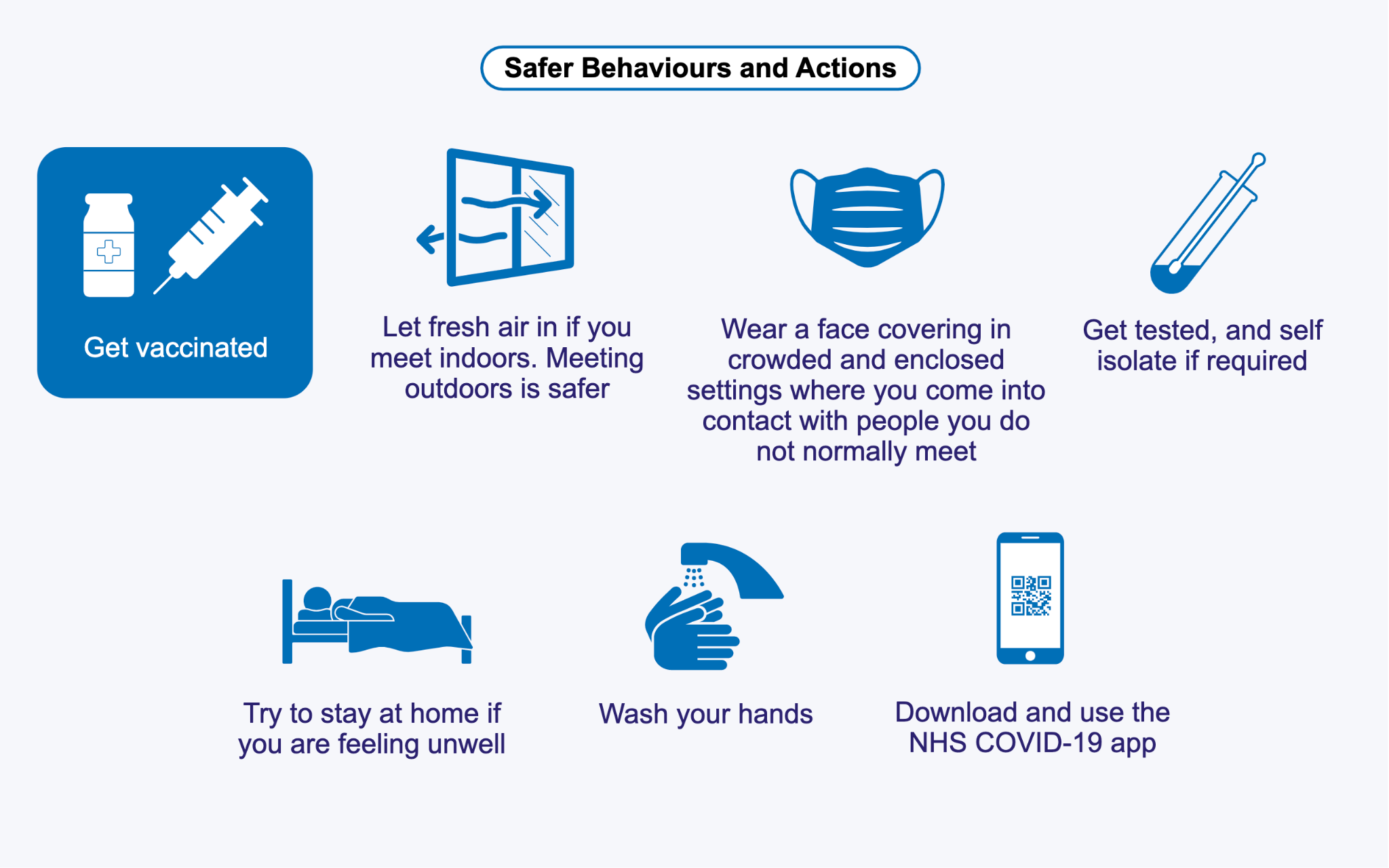
And they also intimate that there will be increased investment in future preventive measures such as improved ventilation in key settings. For example:
- providing further advice and support to businesses to help businesses check their ventilation levels and introduce Carbon Dioxide (CO2) monitoring where appropriate.
- conducting further scientific research to assess ventilation levels in a range of business settings.
- investing £25 million in c.300,000 CO2 monitors for schools.
- improving the management of ventilation across the public sector estate including deploying CO2 monitors in courts as well as targeted rollouts and trials of these monitors in other settings.
- supporting and promoting of pilots of how to limit transmission through ventilation or air purification on passenger rail stock
Is the Private Rental Sector ready for a COVID Winter?
If we start the planning or accelerate the planning process now then as a sector, industry supplier, landlord, tenant or managing agent we should and certainly can be.
Inventory Base provides highly effective inventory and property management software which means that these vital systems such as sensor information and data as well as risk assessments and property checks can be included as a standard feature of any property report or inspection that can be carried in person or remotely with Live Inspections.
Inventory Clerks – Do you know your property report market?
According to recent studies, the private rental sector (PRS) in the UK is not only healthy but steadily, inexorably growing. This is not only due to the rise of what is colloquially known as ‘generation rent’, meaning young people who are struggling to get onto the ladder of property ownership choosing (or are forced) to rent. In almost every age group, the percentage of people living in private rented accommodation is on the increase. As inventory providers; how does this help you identify your target client and how well do you know your property report market?
The private rental sector accounts for over 20% of all households with the largest share of private renters being between 25 to 34 year olds (Generation Z), with a total of more than 1.4 million private renters being in this age range.
Close behind are well over 1 million renters in the over-50s (Baby Boomers: born between 1946 and 1964) bracket now renting. This is compared with barely two-thirds of that number in 2010.
With an estimated 3.87 million people aged between 50 and 54 living in England, they are therefore likely to swell the numbers of 50+ renting in the PRS as more opt for the ease of renting and lower outgoings by moving into smaller and more practical accommodation.
A good point to make is that there is very little sign of this sector moving into reverse or even levelling off in the foreseeable future. It is the second biggest form of housing tenure in the UK and that makes it an extremely worthwhile and viable market in which to establish a presence.
The purpose of a property report is to protect
As an inventory clerk; you provide a property report service that is (often) too easily overlooked by the outsider. However, landlords and letting agents alike are well aware of the vital work you and the thousands of unsung foot soldiers perform. Any property management system relies massively on the services of skilled, experienced, professional inventory clerks because the art of property inspection lies at the heart of protecting a landlord’s investment, enforcing the provisions of a tenancy and preserving a positive relationship between landlord and tenant. Inventory reports and property management oils the wheels of the entire machine.
If you run a business providing inventory and property inspections for landlords and letting agents, or you are considering a move into this area, then the imperatives of any business apply equally to you. To get the most out of your skills and time you really do need to understand the property market. It is easy to research broad statistics like those cited above: it’s a flourishing market full of opportunities. But you need to look more deeply into the requirements and expectations of your potential clients as well as their geographic location and distribution.
Where in the country are the greatest opportunities for providing property reports?
Currently; the South-East has the highest concentration of private rented accommodation, particularly in London and its outer boroughs, but also in most of the larger commuter towns such as Guildford, Maidstone, Reading and Watford. The further west or north you travel, the situation changes but you’ll find that in every one of the major conurbations including Bristol, Birmingham, Manchester and Leeds, the PRS shares similar buoyancy to the Capital.
This is hardly surprising because the market will naturally crystallise around areas with the highest density of housing. Creating opportunity and carving out a geographical niche in one of these areas is the best way to position yourself physically in the property reporting market.
However, when you’re researching territories, you need to teach yourself about any property market conditions that are specific to that area, including but not limited to demographics. Where there is a large population of elderly homeowners, for example, it may not be the best choice for you whereas as in a university town, the constant throughput of students would be perfect albeit busy in tranches such as end and start of the academic year (July to late September).
Canterbury, for example, has a population of about 170,000, but nearly a quarter of that is represented by students. Cambridge is home to 130,000 people, of whom 25,000 are students so the potential to canner the property report market is high.
What do clients look for in a property report service?
The PRS contains businesses that range from landlords with one property to institutional landlords representing pension funds who have recognised the potential returns in this particular sector and have either built or purchased multiple properties across the country creating a wide ranging portfolio or stock.
Getting a foot in that particular door could prove difficult since they will have likely appointed large lettings agencies with their own inventory services. Smaller enterprises may be a better fit and worth pursuing – landlords with one, two or a handful of properties – when you are just starting out so that you are not overwhelmed with work or under-deliver.
Although many landlords may already be using the inventory services of a lettings agent, they are likely to be receptive to the idea of shopping around, especially if you can convince them of the benefits of using a specialist who focuses purely on inspection without the dozens of distractions involved in day to day management of property management.
That means you need to work out how to market yourself and present your service as both excellent and good value.
Give yourself the edge
Every inventory clerk can make claims about their impeccable skills and thorough, methodical approach to reporting. But bringing something tangible to the table is always persuasive. At Inventory Base, we specialise in the development of property management software, which includes everything an inventory clerk could need to carry out the most precise inspections, compile clear, comprehensive yet concise reports, easily share those reports with the client, and store data for monitoring, analysis and future comparison.
Using a property inspection app can give you a professional edge which will help you attract and retain clients. With the average tenancy lasting about two years, each one could be the source of five separate inspections, a check-in, a check-out and three six-monthly interim inspections.
One of the keys to success as an inventory clerk is building a regular client base, because then it becomes easy to quantify your base income through a simple calculation of clients multiplied by properties multiplied by inspections per year. Inventory Base has all the digital tools to help you put the most into your inventory business and get the most out of it.
Once you’ve had a careful look at the market and identified how you can tap into its potential, why not take the opportunity to put some state-of-the-art digital resources into making your business the service of choice in your area? Inventory property management is a much needed service and is a set of skills for which demand is set to grow.
At Inventory Base we can help you grow with it with free trial of our software, bespoke templates and training and support via Inventory Base Academy.
Want to know more? Contact us for more details and start your reporting journey.
Inventory Clerk Self Development – 5 skills every inventory provider should have in their tool kit
Being an inventory provider is perhaps not one of the top 10 career choices but the more you investigate the prospect, the greater the advantages you’ll discover as you get to know what the job entails and the benefits of running your own reporting service. If you long to be an independent, self-employed professional, in control of your time and your work/life balance then this may be the perfect role for you. But what are the 5 skills every inventory provider should have in their tool kit?
Being an inventory clerk is not an easy option. It requires intellectual, interpersonal and practical skills alongside oodles of common sense, patience and the ability to take a wider, more practical viewpoint but the advantages of being your own boss can outweigh any negatives.
Let’s look at 5 skills every inventory provider should have in their tool kit:
The art of dealing with people
Although almost every job involves dealing with people or colleagues either face to face or indirectly through technology; inventory reporting and provision requires a high degree of interactions with both your clients, letting agents, landlords, contractors as well as tenants and other providers. Clearly your priority should always be to your clients, but it is important to establish and maintain a harmonious relationship with all stakeholders that is built on both trust and professionalism.
Sensitivity and tact are vital in order to develop a trust-based relationship – however transient this may be – which will ensure the visit or appointment runs as smoothly as possible for all parties. As an inventory provider, you never know who you will encounter during your working day.
What matters is remembering that each person is an individual, that they are afforded the same levels of respect and courtesy that you yourself would expect. You are in their home, their sanctuary, so your demeanour should always be amenable and helpful and always polite. It should go without saying that you must present yourself as someone who is there to provide a service that is impartial and as equally beneficial to the landlord as it is to the tenant.
Being a resourceful inventory clerk
It is an unfortunate but regular occurrence, mainly due to the fluid nature of the lettings industry, that not all properties you visit are indeed ready to be reported on. Tenants and landlords don’t always see eye to eye which can delay the check out or the property may still have works yet to be completed that impact on the ability for cleaning or maintenance to be completed before you arrive to carry out the report.
This all impacts on your bookings, your onward reports and clerks availability if jobs are having to be moved, cancelled or clerks are being asked to ‘jump in’ at a moment’s notice. As this is a well known problem in the industry
Always have (in your back pocket) a Plan B if you have to rearrange the appointment
Have those options ready and waiting to be put into action for when you talk to the client; tell them what you can and are willing to do for them; they will love you for it and more importantly, will likely think of you first the next time they want a report or property visit booked (if not already a regular client).
Another essential part of your tool kit is an extendable pole for testing alarms or selfie stick. Taking photos of parts of the property you can’t access easily or inspect with the naked eye can be dangerous if you fail to follow basic safety protocols like not standing on chairs or climbing on worktops. Having the right equipment will help you to minimise any potential risks to your safety and well being.
Along with meter, cupboard and access keys; a good property inspection app (Inventory Base) not only helps you detail and record the evidence and information but can act as a useful prompt to help ensure you don’t miss anything as you progress through the property. These are just some of the tools you need to have ready for use at the property whilst ensuring that safety is your top priority at all times.
Thinking on your feet
Dogged determination is a quality that, for some, comes more easily than others but can be a learned attribute. A good inventory provider will look for the workaround rather than accept defeat if they cannot find the meter. Clients expect a lot from an inventory service so only the truly insurmountable tasks should be left uncompleted but always let the client know why, what you have done to try and complete the task and what other options you have available going forward to manage future issues.
Don’t take the easy option and not bother
The most common bug bear is utility meters; they can be as elusive as pink elephants! That said; property inspections are easier to conduct than in the previous years because of the advances in technology that provide apps that work without WiFi, that have built in dictionaries and templates that guide the user as well as training and support. We have moved far beyond the pen and paper!
The ability to think on your feet, to think laterally is a key asset for any inventory provider as every day will, more often than not, require a potential change in the booking or the expected environment that you (thought) are walking into.
You will encounter all manner of practical challenges such as inaccessible smoke alarms and meters, unreachable ceilings and corners, unwieldy furniture and any number of other unforeseen challenges including properties that have yet to be vacated.
Finding a foot hanging out the end of a bed in what is meant to be an unfurnished, empty property is not uncommon!
What you then do in reaction to finding someone at the property that you weren’t expecting (or vice versa) will speak volumes about both yourself as an inventory clerk and as a professional service so you need to think about what your protocols are and should be when dealing with the unexpected.
The measure of how you manage these situations including offering solutions to your client as they will often look to you to sort out any problems or issues. Clearly there are some issues that cannot be easily resolved as often they require the services of other professionals (cleaning contractors, gas or electrical engineers) so your flexibility is a key asset of your service.
Attention to detail
It is a vital skill to make sure that at every stage of the inspection you are focused on the smallest details, not just the glaringly obvious. An inexperienced inventory provider may feel initially overwhelmed especially on the first report when entering a property.
The task ahead might seem daunting and unmanageable. You need to take a methodical approach, breaking the job down room by room; component by component and treat it as a series of compartmentalised inspections. This way you are less likely to be overawed by the scale of the property report or assessment.
As you enter each room, you should only concern yourself with that particular space or part of the property so that you don’t then start to wander and lose concentration. Look for any and all signs of wear or damage or issue, wherever they might be – don’t make any assumptions about the condition of light fittings, windows, electrical sockets or any of the things we might take for granted in our own homes. Part of your job is to both spot and then detail the issues using a fact-based approach.
Inventory Base Academy training will equip you with all the information and tools you will need to carry out the role as an inventory provider. You can find out more here by visiting Inventory Base Academy – Learn How to produce Professional Property Reports
Effective communication
Communication is a key component of your service; it is the basis for everything that you do both in the written word or when speaking to landlords, agents, tenants and other service providers and contractors.
Being able to put clients at ease, get across your point firmly but respectfully is essential so that clients know exactly where they stand, how you will be proceeding and tenants are put at ease and not made to feel subject to unreasonable scrutiny. These skills are even more important when preparing your report.
You are not expected to have the same level of expertise as say an architect or builder would have at their disposal but everything in your report should be clearly set out, factual and evidence based without being overly complicated or strewn with acronyms.
When referring to a particular piece of furniture, you may not know the exact technical terms that apply to it, but you should convey the information in a way the reader can say ‘yeah I get that, it makes sense’.
Whether you train with Inventory Base Academy or complete your own self learning; you need to hone your descriptive powers so that you can give a full account of any issues as seen and can then advise the client as to any next steps they might want to take or need to consider so that they can manage any risks in the property.
Once you start your journey as an inventory provider you will rapidly gather the experience and expertise needed to develop the skills that will empower and support a great service.
The Importance of Inventory Report Training – How Does it Support the Lettings Industry?
Why is inventory report training so important to the lettings industry? The lettings industry relies on specialists, just like any other business sector, to carry out safety checks, repair properties or help the property market to move forward. Inventory providers and clerks are an essential part of the process.
Conveyancers, agents, engineers, plumbers, electricians – are the professionals that are doing all the heavy lifting and are relied upon to provide indispensable services when it comes to running a successful lettings market. However, there is also an underutilised specialist who should be held in the same regard and spoken of in the same breath: the inventory clerk.
It is easy to dismiss the role of an inventory provider as an unnecessary professionalisation of a common-sense function, but the range of skills they each bring to the table can be vast and yet go mostly unnoticed.
Why is that?
In my experience, the lack of understanding around the role is down to a simple fact; the inventory is not a mandatory requirement in the lettings process. A prescribed document, no different to the AST, EPC, safety certificate, would provide a better platform for both learning and understanding of the vital role property reports play.
A comprehensive and robust report underpins and supports the deposit process and has the potential to lose the tenants their deposit due to spurious claims or the landlord access to monies to pay for cleaning or damage caused during the tenancy. But without a mandatory requirement for reports and inventory report training, it’s easy for them to be dismissed out of hand or not afforded the professional respect they deserve.
The inventory (interim and check out) report is seen, in some quarters, as either not necessary so the property is let without any written evidence or an additional financial burden so landlords and or agents complete them ‘in-house’ in order to save money despite the fact that most inventories cost less than 1% of the deposit so the return on investment – (ROI) is high.
This is why inventory report training is so important in the lettings sector.
Although vital and important to reduce disputes, property reports are about so much more. The systematic noting of the property which is a physical, demanding role that commands a high level of detail and even more patience by the provider, is a huge job in it’s own right. A good report will flush out safety issues and provide a platform for future maintenance tasks. A tick box report of the good, bad and the ugly is not sufficient to provide the body of evidence deposit scheme adjudicators need to make a balanced, fair decision. Nor should it be seen as a vehicle to increase an agents profit margin.
Inventory reports are among the most important documents that can impact on the relationship between landlord and tenant, so no tenancy should begin without a comprehensive inventory of a property’s structure, décor, services and utilities, fixtures, fittings, contents and furnishings. If the tenant is taking on responsibility for the care and maintenance of the property (within the legal provisions of the tenancy agreement), it is vital that both parties agree on the content and condition of everything from the start.
The same process must be followed at the end of the tenancy to determine whether the tenant’s deposit can be returned in full or in part and to make sure any loss or damage is remedied or recompensed.
No party enters into a tenancy agreement expecting to have a bad experience or expecting the worst case scenario, but sometimes the unexpected does happen. It is infinitely more preferable to have comprehensive, documented evidence with which to resolve any dispute that may arise over loss or damage, whether accidental or malicious rather than leave it all to chance, fingers crossed hoping it won’t all end in tears. Investing in the right training, advice and guidance is key to providing a quality service in support of the lettings industry.
Inventory clerk training
Inventory Base Academy was formed in 2019 to standardise the reporting sector by training clerks to deliver detailed inventory and check reports supported by regular property inspections. The core aim is to bring about a much needed change and spread awareness across the industry of the need to carry out professional reports not just once, but for each and every report, for every tenancy.
Historically, reports are carried out mostly by independent clerks but with no requirement for training, insurance, DBS checks or any oversight even though there are currently two clerk associations that represent their members; ARLA and AIIC.
The growth in the lettings industry has inevitably attracted new businesses offering inspection services as it’s often seen as an easy way to earn revenue with very little training and or outlay. But there are no short-cuts when it comes to compiling reports that should protect key assets; the property and the tenants deposit. Investment in expert inventory report training is crucial to fulfilling the role of protecting the interests of the landlord and tenant, which is why the right training, CPD accreditation and support now counts for so much when it comes to reducing deposit disputes.
What should inventory report training look like?
Inventory report training and inventory clerk training needs to encompass every aspect of the report type and life cycle of the tenancy to ensure all bases, information and evidence points are covered.
Inventory Base Academy delivers a CPD certified comprehensive course – How to Produce Professional Property Reports – with sections devoted to cementing the reporting framework, guidance on information capture and implementation, advice, and actionable information on:
| What is an Inventory? | What is an inventory report? Types of inventory Why do I need an inventory? |
| Conducting Reports | Inventory reports Interim reports / inspections Check out reports |
| The Report Framework – 1 & 2 | Building the evidence Consistent, concise, comprehensive reporting |
| How to Describe | Kitchens Bathrooms Rooms / areas |
| Core Report Components | Schedule of condition Taking pictures Report considerations Actions Liabilities Keys Meters |
| Understanding Evidence | Objective v subjective evidence Fair, wear and tear Tenant abandonment The adjudicators role ADR – Types of evidence |
| Clerk Safety | Personal security |
| Health & Safety Legal Information | Gas safety certificates Electrical safety Furniture and fittings Blinds and curtains Smoke detectors & carbon monoxide alarms Other goods |
| How to Compile an Inventory Report – Video Tutorials | Video – Entrance hallway Video – BathroomVideo – Bedroom 1 Video – EnsuiteVideo – Bedroom 2 Video – Lounge Video – Open plan kitchen Video – Alarm testing Completed inventory report example Completed checkout report example |
| Useful Information | Essential checklist Useful information and contacts |
| Quick Guides | The inventory process Check-in process Interim visits process Checkout process |
| Resources – Hand Outs | Focus on your business Pain points Customer is king Housing Industry – List of laws and regulations |
Supporting the lettings industry
Both as an agent and as a landlord, investment in the property is not just monetary. Often landlords have an emotional connection as well as the letting agent striving for quality of service that goes beyond bricks and mortar. But each party needs to be focused on providing a safe property for the tenant to call home as well as realising a healthy return on the investment so finding the right tenant is vital and in some respects, is the easy part – although clearly this process too needs to be handled with care and professionalism.
Effective property management is often seen as the jewel in the lettings agent’s crown but can equally be the most difficult, divisive role and a really hard sell, because although rental income is a great source of revenue, the lettings industry is based on unique contractual arrangements which, despite all the controls and procedures in place, can leave the landlord exposed to damage and loss.
In the UK there are somewhere between 4 – 5 million private tenancies and an average of 1.4 million moves in, around, and out of the private rented sector. The property is the key asset but during the let, it is not under the direct control of either the agent or landlord once the tenant moves in so seasoned agents and landlords are acutely aware of how essential it is to keep a firm grip on the property management process through regular property inspections.
Inventory training and report management is key to ensuring that comprehensive, robust and evidenced inventory reports, interim inspections and checkouts include all the vital information required and are captured pre, mid and post tenancy to ensure accurate records are maintained. This will inevitably have a postive impact on minimising costs as (ideally) the third party information is unbiased, clear, factual and often removes the emotions associated with parties locked in a dispute.
Property inventory software
Increasingly, clerks, property managers and landlords are taking advantage of advancements in technology to improve the accuracy of inventory inspections and reports as well as reducing the labour-intensive work involved. The use of Inventory Base property inspection app is now widespread and forms part of the inventory clerks training to ensure that not only the correct information is captured but that it is then supported by equally robust audit trails, share history, date and time stamped pictorial evidence and digital signatures so that every potential obstacle to a dispute is mitigated.
At Inventory Base we specialise in providing these digital solutions to ensure accuracy of the report, standardisation of terminology, comprehensive and robust evidence and the ability to be time and cost-efficient. When utilised by trained individuals with experience and expertise in the role of a clerk, reports are detailed, comprehensive and can provide an accurate and, most importantly, reliable record of the property.
With our additional resources, free webinars, blogs, podcasts and support hub; join in, learn and share your expertise; Inventory Base Academy
Is pet odour making rental properties ”Eau de No Let’?
You can be forgiven for thinking that a house that smells fresh and clean is, in fact, clean because that’s what we associate with the various odours we pick up on or notice in and around a property. But if a distinctly unpleasant pet odour is prevalent; is that a barrier for potential tenants? Can sprays and scented candles mask the signs that something isn’t quite right or is pet odour making an ”Eau de No Let’ out of rental properties?
Smells are not always associated with unpleasant memories. Some odours can take us back to a favourite holiday destination, to a certain moment in time or remind us of when we experienced a great meal with friends or family. It can help us to build a very powerful memory.
Unpleasant odours though, can equally create a bad experience and can go on to create a huge barrier to letting the property. If a prospective tenant finds the cooking odours, pet smells or damp a turn off on viewing it’s likely the rental will remain vacant until the issues are addressed.
Void periods in any rental process can be expensive to both the landlord and letting agent and can cost an average of 4.9% of the gross annual rental income. Poor property conditions can also decrease the rental value so it’s in everyone’s interest to address any issues at the property quickly.

But if an issue is lurking beneath the fresh smell of coffee or baked bread will the inventory clerk pick this up? It’s important to remember that bad smells can be a source of evidence during a deposit dispute or if the property is not odour and or issue free at inventory or when the tenants hand back the keys at the end of the tenancy.
With the number of households occupied by private renters increasing in England (currently 4.44 million – around 18.7% of all private rented property; (Statistica) the issues associated with renting out a property will naturally increase especially as we are at home more and as many more people are opting to work from home.
Our ‘traditional’ understanding of wear and tear needs to be revisited as it is somewhat outdated due to the change in all our circumstances over the past year or so. This is likely to be further impacted by a significant increase in the number of pets – the latest pet data highlights that there are now 12 million cats, 12 million dogs and a number of small birds, animals and reptiles making up the 34 million pets in the UK that are an integral part of our family life.
Inevitably; with pets, there are likely to be – let’s say – the odd issue and accident. And let’s not be squeamish about this. We all need to poop, we all make smells (some of which certain members of the family seem quite proud of!) and we will all have accidents at one point or another.
Even pets who are well-trained may have the odd accident which can lead to stains and pet odour lingering for months in and around the property. Luckily, most pet owners are responsible – as are most tenants.
Housing pets, despite the odd accident, doesn’t necessarily mean that any resulting stains or pet odour will be long lasting. However, there will be a small minority of tenants who do not treat the property with as much respect as others – raising the issue of deposit disputes for any damage caused.
But how do we as inventory providers work out whether the odour was the dog, the cat or something more sinister causing you to screw up and pinch your nose as you navigate the rental?
The human nose is a very unique bit of kit. It can distinguish at least 1 trillion different odours. According to scientists who study smell; humans were only thought to be able to detect about 10,000 odours whereas domestic dogs have the ability to detect up to 100,000 times more than their human counterparts which is why dogs are used by law enforcement across the world to sniff out drugs and explosives. And in an ongoing study; BBC news has revealed that dogs are even being trained to be able to detect COVID in humans with up to a staggering 88% accuracy.
With such a sophisticated piece of equipment at our disposal, how do we translate what it is we are detecting and showcase in the inventory and checkout reports what we can smell but can’t always show?
One of the biggest issues we have as inventory suppliers is how we convey what it is we are noticing or picking up in the property. Marks and damages are relatively straightforward when it comes to evidence, whereas smells and odours can be very subtle and difficult to associate with something that the report reader can grasp and put into context with limited visual evidence in the report.
Creating a ‘minds eye’ view
In your report you should attempt to draw a picture for the reader of what it is you have noticed or have found, describe what it is you are detecting and then search for the evidence to back up your theory.
So you should be asking yourself questions such as:
- Is it a musty odour? This could be linked with mould or mildew at the property. Look for light brown or black spots often found behind sink cupboards, in wardrobes and cupboards or lower corners of the room.
- Is the odour more likened to the smell of a very well used and probably not clean toilet or bathroom? Look for evidence of a lack of cleaning; grubby surfaces, heavily stained toilet bowls or discoloured grouting.
- Is it more acidic; similar to ammonia ? This could indicate pet urine especially if the animal hasn’t yet been neutered. Cats especially will ‘mark their territory’ meaning you often find the odour more concentrated in corners or areas that cat has frequented.
- Is the odour similar to cigarette smoke or a sweet vaping aroma? Look for ashtrays, cigarette ends near the front or back door. Are there small burn marks on window sills or near the doors that were not seen at the inventory? Another indicator could be ‘nicotine staining’ of the walls or woodwork. Do they appear more yellow in colour?
- Is the odour more of a plastic-burning like smell or ‘fishy’ odour? This could indicate an electrical fault. Look for signs of burning on socket plates or plugs. Is there electricity at the property or has the fuse box tripped because an electrical item has overloaded and shorted out creating the smell?
- ‘Wet dog’ is a commonly used phrase to indicate there has been a pet at the property. Look for signs of toys, faeces in the garden, hair or fur in or on carpets/furnishings, scratches to external doors to help you provide the proof that an unauthorised animal has been living at the property, or perhaps one that has permission has caused the damage now evidenced in your report.
Odours are a vital part of your evidence as a property reporting expert but without ‘smellovision’ the reader is relying on your powers of description and your client and the adjudicator on your powers of deduction. This is how liability can then be fairly apportioned; for more infraction on how to, our Deposit Disputes-Apportioning Liability course is the perfect way to polish your knowledge and skillset.

How do you then showcase what you believe to be a pet odour at the property?
Be clear, comprehensive and concise with descriptions, state what it is you’re detecting; can you liken the smell to something that you can describe such as damp or pet urine?
Photograph or video the area or item where the odour is at its most pungent; describe any change to carpet or flooring like staining or wetness in the areas. Note if the item appears discoloured or faded – this might indicate the odour has penetrated the surfaces. For example, a mould marked wardrobe would likely have a white film/residue and possible black spots to its surface, along with the musty odour normally associated with old antique shops.
Most properties have a neutral smell; nothing specific or unpleasant so are often overlooked and thought of as benign and not worthy of note. But if you set the marker early on i.e at inventory then, as with any change to the property you would usually note such as a change in wall colour or level of cleanliness, the odour or smell in the property should also be noted to offer a benchmark for the adjudicator to understand when a change occurs.

You can find out more about how to manage the often thorny issue of apportioning liability with our CPD accredited course – Deposit Disputes – Apportioning Liability.
Watch our webinar: The Inventory Super Sleuth – How To Spot Pet Damage about how inventory providers can ‘spot’ damage, what to include in the property report and why you need to look closely not just at check out but at the start of the tenancy!
InventoryBase residential property and interim report templates have been updated to provide a field and prompt on property odours. Visit our account library and download the latest property templates to improve your reports and service.
Protecting the Deposit – Why tenants should insist on an inventory report
The relationship between tenants and landlords can be precarious at the best of times and as a tenant, you can sometimes feel at a disadvantage. What is a home for you, for the landlord it is either a business asset or a family home rented out for a variety of factors, so each party will have an emotional attachment. And this is not a criticism of the reasons behind why a landlord offers their property for let, more to showcase that the renting out of a property is not a straightforward business transaction.
If the relationship isn’t equally balanced, it’s understandable to feel disadvantaged, but the key to a successful tenancy is to work with the landlord (and letting agent) so that you each get what you need from the relationship.
From the landlord’s standpoint; legislative changes have shifted the balance towards a more tenant centric model that has, at its core, the right intentions, however the results of the Government’s policy on protecting tenants rights have, for many landlords, meant that the relationship now feels less than equal.
The changes have led to the passing of the Tenant Fees Act, tighter restrictions around safety in the home with Fitness For Human Habitation and the most recent of changes; compulsory EICR reports as of 1st April 2021.
But this isn’t all one-sided; as tenants, you have to jump through a number of often difficult hoops to both prove that you can afford the rental property as well as provide proof of the right to rent. You have to put down what is often a large sum of money by way of deposit which effectively indemnifies the landlord should you fail to pay the rent, damage the property or fail to ‘act in a tenant like manner’ when it comes to the upkeep of the property. By the time the contract is signed, you’re probably just glad to have secured somewhere to call home!
So you can be forgiven, then, for treating every part of this process as just one big hurdle after another, with very little by way of security for you as the tenant when it comes to the deposit as, under the Tenant Fees Act, landlords cannot charge for the report so effectively you are handing over all control to the landlord.
But that doesn’t have to be the case when it comes to the inventory and or check out report.
Many assume that the property inspection is only for the benefit of the landlord that produces a rather dull bureaucratic itemisation of the property’s contents that is biased in favour of the landlord, isn’t it?
Actually, no…..in fact it’s far from that!
As the tenant; you might feel that this is simply a matter for the landlord, and any landlord wishing to protect their investment will certainly attach a lot of importance to the inventory. But it is just as important to you as the tenant and to not have such a report in place can prove to be an expensive mistake.
As tenants, this is your deposit – not the landlords so how can YOU protect it?
Let’s start with some background as to what inventories are and, more importantly, do.
An inventory is carried out just before or on the day the tenancy starts and should detail the property, any outbuildings and garages including gardens and any areas that as the tenant you will be responsible for throughout the tenancy.
This includes every room, the type and condition of the decoration, flooring, fixtures and fittings plus any furniture present. Effectively; anything you can see at the property should be detailed, commented on and a factual description of the condition captured along with enough pictures or video to evidence the report.
The process has been much improved with advancements in technology meaning reports are captured on an app (in most cases) with pictures automatically dated and timed to ensure that the evidence can stand up to scrutiny both in a deposit dispute and or (if needed) a court of law.
By commissioning an inventory report, the landlord is seeking to protect the property by having an accurate record of the conditions and contents as well as recording the types and function of smoke alarms and also utility meters.
This is a great way, from your point of view as the tenant, to protect your deposit as all good inventory reports should have a mechanism in place so that you can also make comments, upload pictures and sign the report so that you too have a record.
Inventories are intended, as with all legal documents, to provide certainty. To achieve this, they must be factually transparent and mutually agreed. For that reason, it makes sense to commission a third party, impartial and experienced property report supplier.
So let’s look at the key reasons and why it’s in your interest as the tenant to be protected by a thorough, accurate and impartial inventory, check-in and check-out reports
1. The inventory provides you, the tenant, with very clear information and guidance as to the condition of the property that you will be responsible for during the tenancy.
2. An independent report provides you with the right to highlight any issues not recorded or areas that need attention including maintenance and or repair before or as you move in.
3. The Check in provides the opportunity to pick up on any changes since the inventory was compiled especially if additional cleaning or maintenance / repairs have taken place as well as noting the meter readings and listing all the keys that are provided.
4. A professional report will list all the smoke and carbon monoxide alarms at the property and whether they are emitting an audible tone. Safety in the rental property is paramount!
5. An independently compiled inventory will make it much easier to distinguish between damage and the reasonable wear and tear legally allowed for when renting a property.
6. A full side by side check out is vital if a dispute arises between yourself as the tenant and the landlord. The evidence needed by the deposit scheme adjudicator would need to include the inventory, check in, any interim inspections and the check out otherwise your defence against the landlords claim could fail.
Ultimately, it’s about your deposit, your money.
The expectation of all tenants should be that after handing over the deposit to the landlord at the start of the tenancy, that you should get it back in full at the end if there are no damages, cleaning issues or rent arrears levied against the deposit.
But how do you prove you left the property in the same (or not better condition) than when you received the keys and moved in? The same is true for the landlord, of course – the cost of any unreasonable loss or damage is likely to be the responsibility of the tenant, but any material change must be proven so there is a need to rely on these documents to ensure your responsibility is not unjustly extended.
Along with the tenancy agreement and your rent receipts, the inventory report is the third most important document in the entire rental relationship so why entrust your deposits safeguarding to anyone else?
Digital inventories conducted by an experienced and reputable inventory clerk is one of the surest means of guaranteeing a report that is impartial, accurate, detailed and referenced and therefore more likely to hold up to scrutiny in a dispute.
InventoryBase – Inspection and Property Inventory Software made simple
The Importance of Inventory Reports – Should Price Trump Quality?
The aim of an inventory (and interim and check out reports), is to protect the landlord against the results of damage or neglect and the tenant from unfair accusations of misuse or failure to care for the property.
Disputes often arise from disagreement over costs being levied against the deposit due to a lack of upkeep, maintenance or the tenant failing to behave in ‘a tenant like manner’ during the period of the tenancy.
And the whole point of a deposit is to provide landlords with the confidence that the tenant takes seriously their role of ‘guardian’ of the rental property as well as to protect both the landlord and their assets against potential damage or additional costs from non payment of rent.
So, with all the protection the deposit affords both the tenant and the landlord; where do inventory reports fit in?
Deposit background information
Deposit Protection was introduced in April 2007 as part of the Housing Act 2004 for all AST’s in England and Wales where a deposit is taken (Scotland have their own rules).
For absolute clarity – the deposit for any tenancy belongs to the tenant – end of, no discussion, not negotiable.
The ban on fees further solidified this position with the introduction of ‘The Tenant Fee Ban’ on residential letting fees that came into force on 1st June 2019.
The law clearly states that in addition to rent, lettings agents can only charge tenants (or anyone acting on the tenant’s behalf) the following permitted payments:
- Holding deposits (a maximum of 1 week’s rent)
- Deposits (a maximum deposit of 5 weeks’ rent for annual rent below £50,000, or 6 weeks’ rent for annual rental of £50,000 and above)
- Payments to change a tenancy agreement eg. change of sharer (capped at £50 or, if lower, any reasonable costs)
- Payments associated with early termination of a tenancy (capped at the landlord’s loss or the agent’s reasonably incurred costs)
- Utilities, communication services (eg. telephone, broadband), TV licence and council tax
- Interest payments for the late payment of rent (up to 3% above Bank of England’s annual percentage rate)
- Reasonable costs for replacement of lost keys or other security devices
- Contractual damages in the event of the tenant’s default of a tenancy agreement
- Any other permitted payments under the Tenant Fees Act 2019
The Act also states that agents and landlords don’t have to pay back any fees they have charged a tenant before 1st June 2019.
This means that whereas pre tenant fee ban, the landlord and tenant would (normally) share the cost of the inventory and checkout report; the financial burden of providing the reports now lies solely with the landlord.
What do Inventory Reports bring to the table?
The inventory serves as an official record of what is included in a rental property, and what condition the property is in, at a particular point of time prior to or on the day of the check in.
It helps identify the respective responsibilities of both the landlord and tenant for the care and maintenance of the property.
A comprehensive report serves as a key form of evidence in settling a dispute, especially if the landlord seeks to withhold some of the tenant’s deposit for perceived damages and or cleaning issues. Under the current regulations contained in the Tenancy Deposit Protection Scheme 2007, this is almost impossible to do if an accurate detailed inventory does not exist – hence why there is an increasing need for comprehensive inventories.
However; an emerging issue is that (some) providers feel pressured to reduce report costs as agents seek to recoup lost revenue. Landlords may also be looking to reduce overheads in light of extreme pressures on their finances, mostly due to increased legislation, taxes and the cost of maintaining the property whilst rent arrears, as a direct result of the eviction moratorium, continue to accumulate.
A recent poll by InventoryBase Academy has indicated that many providers feel that the report fee does not reflect the skill and detail required to provide a robust document. This further compounds the assertion that fees for property reports are often the main consideration when securing services instead of the protection they provide.
Has the pandemic impacted the Inventory reporting market?
Looking at the rental sector – it is already large and growing at an accelerated pace so any impact from the pandemic appears somewhat limited in terms of growth.
Figures for 2020 show that there are 5.4m houses in PRS with 4.4 million social renters and 2m landlords. An estimated £58bn was collected in rental payments alone in the past financial year. So, as it stands, the evidence points to a ‘healthy’ industry.
With the average length of a tenancy around 2 years; a quick calculation based on one inventory, one interim inspection and one check out per property every two years; the reporting market is generating around 6.6million reports (3.3 million each year). Multiply that by a conservative £60 per report; the (estimated) value of the property reporting market (PRM) is around £396m (£198m per year).
Although the rental market appears buoyant, there has never been a full scale study of the inventory supplier market so it’s difficult to really say whether there has either been an increase or decrease to reporting numbers or revenue. What an interesting insight that would be!
What is clearly in evidence, is a flourishing housing market that continues to increase in both stock and value. According to Savills (2021); the total value of the UK’s housing stock is estimated at £7.56trn; an eye watering increase of £380bn compared to 2019. Savills states that the UK Housing market now stands at four times the value of all companies in the FTSE 100.

* Savills – Property Industry Eye; March 2021
The number of households occupied by private renters in England are estimated at 4.44 million. This equates to around 18.7 percent of dwellings in England occupied by private renters in 2020, with around 16.7 percent of dwellings occupied by social renters.

* Number of households occupied by private renters in England from 2000 to 2020 – Statistica
As affordable housing still languishes behind need, the number of properties moving into the Private Rental Sector (PRS) is likely to increase. Finances remain tight because of the lack of jobs and lower incomes due to furlough. The inevitable pressures of the pandemic show little sign of easing, with long term effects largely unknown. What is clear, with known restraints on people’s ability to afford a mortgage; the numbers of people turning to renting is set to increase despite the Government’s efforts to turn Generation Rent into Generation Buy.
How much is spent on rent in the private sector?
The median monthly rent was £725 for England, recorded between October 2019 and September 2020; this is the highest ever recorded (ONS).
London figures are higher due to the location with a highest median monthly rent noted at £1,435; this is nearly double the median monthly rent for England.

* Average weekly rent of private renters in England from 2008 to 2020 – Statistica
So based on the average of £725; a rough calculation of 5 x weekly rent for England would mean a deposit of £836.54 (TDS Deposit Calculator)

With an average inventory report costing around £60 for a 2 bed house (unfurnished), the report cost v the deposit is less than 1% (0.8%) so this begs the question; are report costs too low and do they reflect the detail and skill of the inventory provider or service?
Are we not at risk of devaluing the benefits of property reports?
The sole purpose of the inventory is to protect.
To protect the tenants’ deposit; protect the landlords assets, so are we not putting at risk the benefits of inventories and devaluing the role they play in favour of penny pinching when, in fact, property reports are so often the key to a successful tenancy?
With any type of service or product; cost is always going to be a key consideration alongside service delivery. We are all feeling the strain on our finances during what has been a very difficult period which has inevitably developed our price-conscious attitude. That said, I don’t necessarily feel that this is a negative attribute; counting the pennies will save pounds but not if it is to the detriment of the landlord or tenant when the report fails to hold up its end of the bargain and protect the deposit.
I do, however, think that over the past year or so we have started to recognise that quality is as equally important as price if not more so!
My question to you, the industry is: should price continue to trump quality?